Global payroll, without the guesswork

Discover top global payroll services, what providers include, and how to evaluate them. Independent advisory support for global-first companies.
  • Vendor-neutral guidance
  • Clarity before commitment
  • Heightened compliance and reduced operational risk
  • Faster, more confident decisions
Top providers navigating global payroll, employment and workforce employment

Independent global payroll advisory

We uncover country-specific risks, responsibility gaps, and edge cases before they become problems.

True provider comparison

Compare providers across coverage, pricing models, service depth, compliance responsibility, and scalability

Clear accountability boundaries

Understand where provider responsibility ends and where yours begin. Compliance, filings, data accuracy, and local nuances

Right-fit architecture

Discover whether you need a single global provider, a multi-vendor payroll stack, or a combination of payroll, EOR, and local entity support

What to expect from a global payroll provider

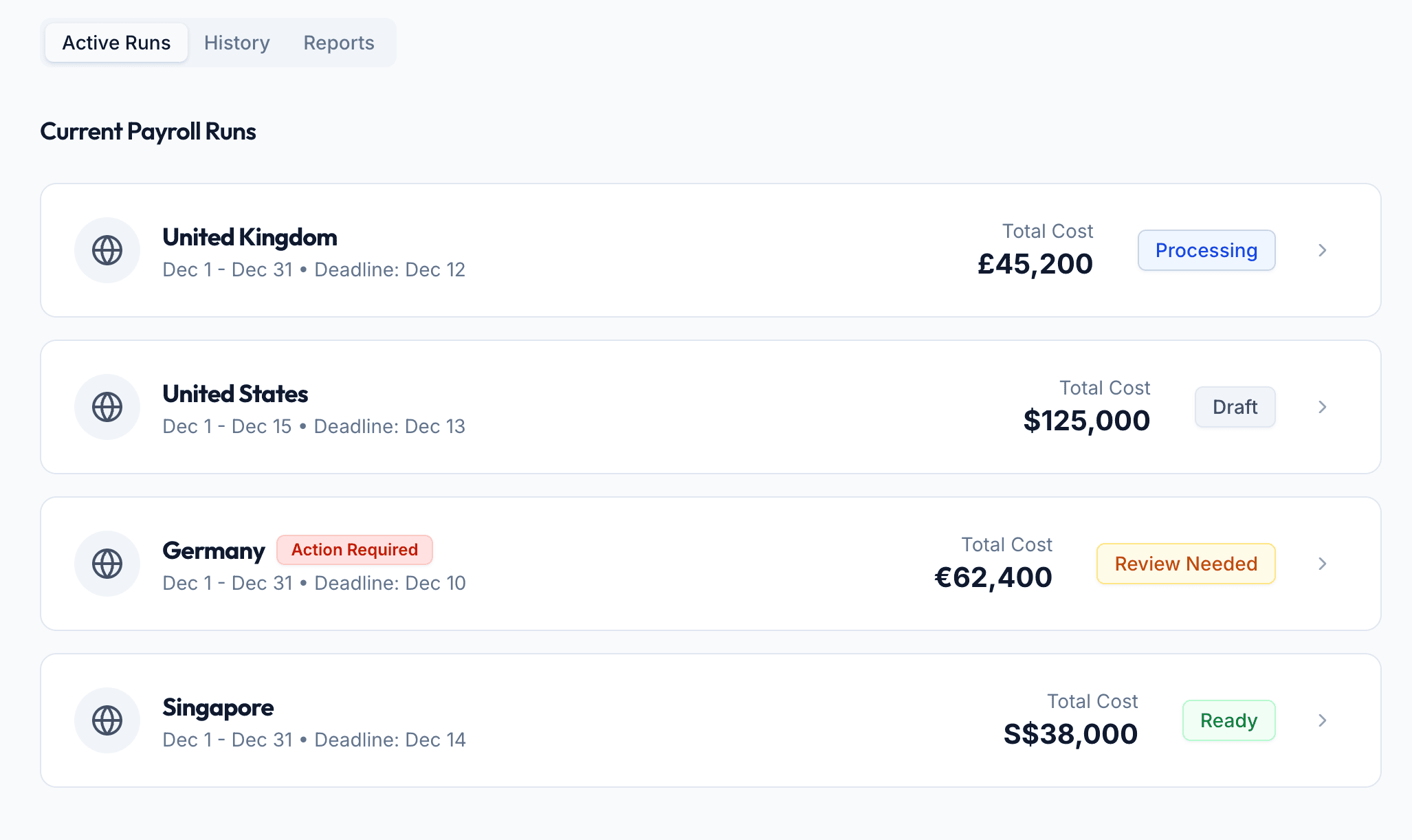
1. Compliant, multi-country payroll execution

Good global payroll providers enable you to process payroll across multiple countries while remaining compliant with local employment and tax regulations. This typically includes:
  • Country-specific gross-to-net calculations
  • Statutory tax, pension, and social contributions
  • Local payroll calendars and cut-off times
  • Required filings and reporting to authorities
Dashboard mockup
Dashboard mockup

2. Integrated global payroll data and reporting

Modern providers should offer centralized visibility across all payroll regions, allowing finance and HR teams to:
  • View consolidated payroll costs
  • Break down spend by country, team, or entity
  • Export data for accounting and reporting
  • Maintain audit-ready payroll records
This replaces fragmented local vendor relationships and manual consolidation

3. Salary, tax, and statutory deduction accuracy

Payroll accuracy is critical. Providers should automate tax calculations, update rules as regulations change, and validate payroll runs to minimise errors and rework.
  • Automated tax calculations
  • Built-in statutory deductions
  • Payroll validation before pay runs
Our advisory evaluates each provider’s payroll accuracy, cadence, automation, and cross-country consistency.
Dashboard mockup
Dashboard mockup

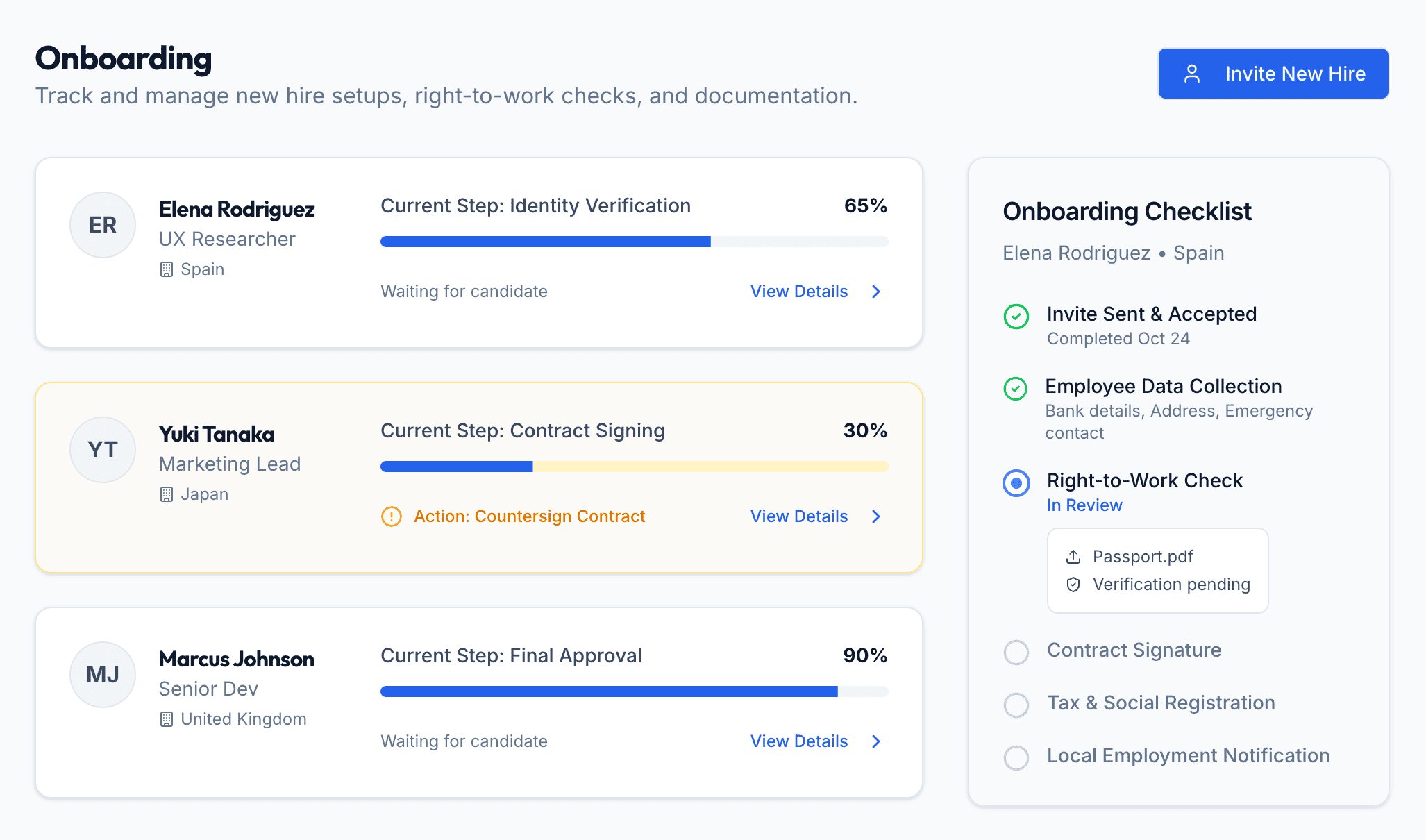
4. Onboarding, documentation, and right-to-work alignment

The best global payroll providers often support payroll-related onboarding by:
  • Collecting payroll-required employee information
  • Validating tax and identity documentation
  • Aligning payroll records with right-to-work requirements
  • Ensuring payroll setup reflects local employment status
This reduces misclassification and compliance exposure.

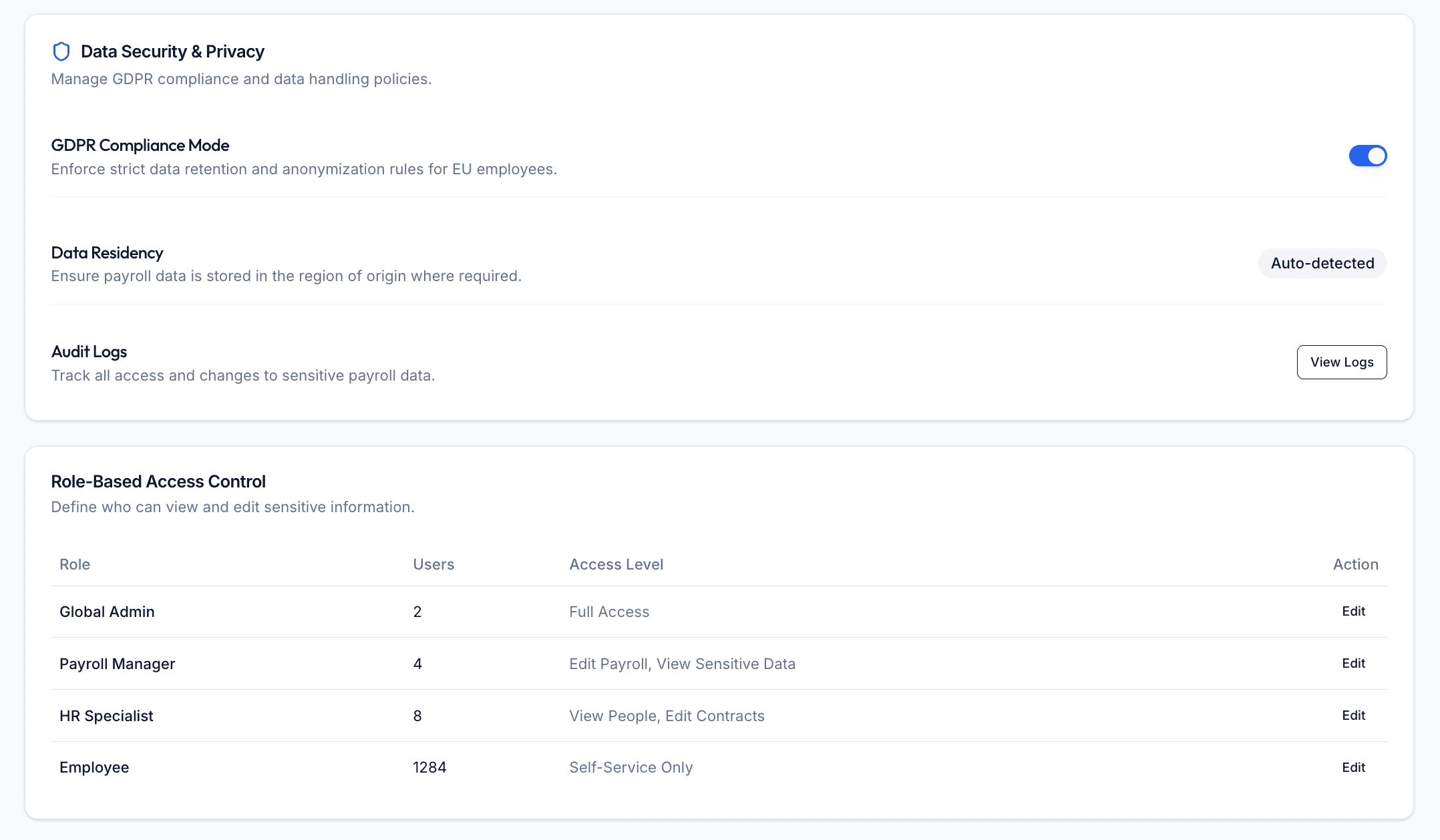
5. Secure handling of sensitive payroll data

Payroll involves highly sensitive personal and financial data. You should expect:
  • GDPR-compliant data handling
  • Role-based access controls
  • Secure storage and transmission of payroll data
  • Clear data ownership and retention policies
Security standards should be explicit, not implied.
Dashboard mockup

Transparent, predictable payroll costs

Global payroll pricing models vary significantly. A credible provider should clearly explain how pricing works and what is included.
  • Per-employee or per-country fees
  • Setup and implementation costs
  • Ongoing payroll and support charges
  • Transparent fees for off-cycle payroll, corrections, or custom reporting
Lack of pricing clarity is often a signal of future complexity.
Dashboard mockup

Why choose We Are Distributed?

100%

100% vendor-agnostic recommendations — no hidden agenda

7 minutes

Get matched & see real demos from providers in minutes, not weeks

No vendor lock-in

Test the full gamut of global payroll providers before deciding

Global payroll FAQs

Everything you need to know about global payroll providers and what to look out for...
What is global payroll, and why is it complex?
Global payroll refers to the process of paying employees in multiple countries while complying with each country’s tax laws, labor regulations, and social security requirements. The complexity arises from differences in legal frameworks, currencies, benefits, and reporting obligations, making it challenging for companies to manage without expert guidance.
How does global payroll differ from local payroll?
Local payroll focuses on a single jurisdiction, where compliance rules are uniform. Global payroll requires managing multiple payroll systems simultaneously, each with unique tax codes, reporting requirements, currencies, and labor laws. The challenge is creating consistent payroll processes that still respect each country’s legal requirements.
What is an Employer of Record (EOR), and when might it be relevant?
An Employer of Record is a legal entity that employs workers on behalf of a company in a specific country. It is most relevant when a company wants to hire internationally without setting up a local legal entity. The EOR assumes responsibility for payroll, compliance, and statutory filings, allowing the company to manage operations while avoiding legal risks of non-compliance.
How do payroll taxes and compliance work internationally?
Payroll taxes differ in structure and rates across countries. Some countries require employer contributions to social security, healthcare, or pension funds, while others mandate specific insurance or unemployment contributions. Income tax withholding rules also vary, and many countries have strict filing deadlines. Missteps can result in fines or audits, so mapping out the obligations in each country before hiring is essential.
Can companies maintain control over employees while outsourcing payroll responsibilities?
Yes, operational control such as setting work schedules, performance expectations, and tasks remains with the company. The challenge is ensuring that administrative and legal responsibilities, such as paying taxes and benefits correctly, are met. Understanding which responsibilities stay with the company and which are handled by the EOR or payroll provider is critical for compliance.
What considerations are important for paying employees in different countries?
Key considerations include currency, pay schedule, statutory benefits, and local labor regulations. For example, some countries mandate monthly payments, while others allow biweekly. Currency fluctuations can affect employee net pay and accounting. Benefits such as health insurance, pension contributions, and paid leave must meet local minimums. Companies must ensure these requirements are built into payroll calculations.
What are common challenges when terminating employees internationally?
Terminations are highly regulated and vary significantly by country. Requirements can include advance notice, severance pay based on tenure, filing notifications with government authorities, and handling accrued benefits. Misunderstanding these obligations can trigger legal claims or fines. Preparing standard termination frameworks for each country before hiring helps avoid costly mistakes.
How should companies approach global payroll reporting?
Reporting should clearly capture gross salaries, deductions, benefits, taxes, and employer contributions for each country. Consolidating reports for multi-country payroll is challenging due to differing accounting standards and tax rules. Using a standardized format for internal reporting helps reconcile costs across jurisdictions and supports auditing or financial analysis.
What role do benefits play in global payroll?
Benefits are often legally required and vary widely by jurisdiction. Health insurance, retirement contributions, paid leave, and other perks must meet local statutory minimums. Offering benefits that align with local norms improves employee satisfaction and ensures compliance. Payroll calculations must account for both mandatory and optional benefits to avoid errors.
What security considerations are important in global payroll?
Payroll contains highly sensitive personal and financial data. Companies must implement strong access controls, encryption, and secure storage practices to prevent breaches. Compliance with data privacy laws such as GDPR is mandatory for international operations, and any misstep can lead to fines and reputational damage.
How should companies decide whether to manage payroll in-house, through an EOR, or with a third-party provider?
The decision depends on scale, geographic reach, internal expertise, and risk tolerance. In-house payroll can work for a single country or small team but becomes unmanageable across multiple jurisdictions. Third-party providers or EORs are often more efficient for international operations but come at additional cost. Evaluating complexity, compliance risk, and internal capacity is critical before choosing a model.
Avatar photoAvatar photoAvatar photo

Ready to find your perfect global payroll provider?

Get personalized recommendations from our independent experts. No cost, no obligation.
Get matched free (soon)