How an employer-of-record arrangement actually works in the UAE — legal frameworks, visas and sponsorship, social security obligations, real costs, and how to choose a provider.

A global company can find the right UAE-based developer, designer, or consultant and still discover that hiring them isn't as simple as signing an offer letter. The worker may need a sponsoring employer, a registered contract, a work permit, a compliant payroll route, and the correct employment regime for the location where they work.
That's where an Employer of Record (EOR) in the UAE can help. An EOR acts as the local legal employer while the international company manages the employee's daily work, goals, and performance. The arrangement can support faster market entry without requiring the client to establish its own UAE subsidiary, but it doesn't remove the need to understand local jurisdiction, sponsorship, payroll, and statutory obligations.
A European technology company might want to hire a software engineer living in Dubai. The hiring manager has agreed on the role, the candidate has accepted the compensation package, and the team is ready to begin onboarding. Then the legal review raises a basic question: which UAE entity will employ and sponsor the worker?
An Employer of Record can serve as the company's on-the-ground employment arm. It signs the local employment contract, manages visa and work-permit administration where applicable, runs payroll, and handles statutory employment obligations. The client company still directs the engineer's work, but the EOR carries the formal employer responsibilities.
That model is useful for global companies testing the UAE market, hiring a small local team, or supporting distributed employees without immediately creating a subsidiary. It can reduce the administrative burden associated with incorporation, licensing, payroll setup, and immigration coordination, although the commercial value depends on the provider's scope, fees, and ability to operate in the correct jurisdiction.
Practical rule: An EOR is not simply a payroll vendor. In the UAE, the provider's legal entity and sponsorship authority can determine whether the employment arrangement works at all.
The central challenge is that the UAE doesn't operate under one uniform employment framework. Mainland hiring generally sits under federal employment law and MoHRE administration, while ordinary free zones may apply federal law through zone-specific processes. DIFC and ADGM use separate employment regimes, creating a dual-compliance environment for international employers.
The sections ahead explain how the model works, how mainland and free-zone rules differ, what happens during visa and payroll administration, how nationality affects statutory costs, and how ADGM's newer remote-work rules change the decision. The final focus is provider due diligence, because a credible EOR must match the worker's location and governing authority rather than offer a generic “UAE” solution.
An EOR resembles a fully staffed branch office that another company rents for employment purposes. The branch has the local legal structure, payroll capability, and administrative staff, while the client company decides what work the employee performs and how the employee contributes to the wider business.
That distinction separates an EOR from both a contractor arrangement and a subsidiary.
A contractor usually provides services under a commercial agreement and remains responsible for their own business obligations. An EOR employee, by contrast, enters an employment relationship with the EOR. A subsidiary gives the client direct control over the local employing entity, but it also brings incorporation, licensing, banking, reporting, and ongoing administration.
The EOR normally manages the formal employment layer:
Employment contracts: The provider issues a contract aligned with the governing authority and the worker's status.
Registration: Mainland employees are registered through MoHRE, while free-zone employees follow the relevant authority's process.
Payroll: The EOR calculates salary, statutory deductions, benefits, and other contractual payments.
Immigration administration: Where required, the EOR sponsors the work visa and coordinates related identity and labor documentation.
Offboarding: The provider calculates final entitlements, processes cancellations, and closes the employment file.
The client company retains operational control. It normally selects the candidate, defines the role, assigns work, evaluates performance, and decides whether the engagement should continue. The EOR supplies the compliant employment wrapper, but it shouldn't become the employee's day-to-day manager.
In the UAE, this wrapper is regulated. Private-sector workers are registered through MoHRE or the relevant free-zone authority, and mainland employment contracts must be registered before work begins, according to the UAE EOR regulatory overview. Mainland employment is administered through MoHRE, while DIFC and ADGM apply their own employment statutes and courts.
A person who works continuously for one company, follows its direction, and depends on an employer-sponsored visa may not fit neatly into an independent contractor model. Re-labeling the arrangement doesn't change the underlying immigration or employment requirements.
An EOR therefore does more than invoice the client for a monthly service. It connects the employment contract to a licensed entity, the worker's sponsorship status, the correct payroll system, and the authority that regulates the relationship.
Companies comparing models can use global Employer of Record guidance to distinguish EOR employment from direct hiring, contracting, and other international workforce structures.
The most important UAE hiring question is often not “Can the company use an EOR?” It's “Which authority governs this employee?”
Federal Decree-Law No. 33 of 2021 is the core mainland employment framework for EOR arrangements. It took effect on 2 February 2022 and was later amended by Federal Decree-Law No. 9 of 2024, as summarized in this analysis of DIFC, ADGM, and mainland employment law.
Most ordinary free zones also follow the federal framework, although their authorities administer employment processes locally. DIFC and ADGM are different. They operate under separate employment laws, institutions, and courts, so a provider that can handle mainland MoHRE employment may not automatically be suitable for a worker governed by DIFC or ADGM rules.
| Regime | Governing law | Authority | Visa scope |
|---|---|---|---|
| Mainland | Federal Decree-Law No. 33 of 2021, as amended by Federal Decree-Law No. 9 of 2024 | MoHRE and relevant UAE immigration authorities | Sponsorship through a properly licensed mainland employer |
| Ordinary free zone | Federal law may apply with zone-specific administration | Relevant free-zone authority | Sponsorship and work authorization depend on the zone |
| DIFC | DIFC employment regulations | DIFC authority and courts | DIFC-linked employment and immigration processes |
| ADGM | ADGM employment regulations | ADGM authority and courts | ADGM-linked employment and immigration processes |
The UAE's official platform also explains that each free-zone authority has its own employment law and that free-zone employees are generally not governed by the UAE Labour Law. That distinction makes location mapping essential before a contract is drafted or a payroll account is configured.
A practical review starts with four questions:
Where does the worker physically work? A Dubai mainland address, a free-zone office, and an ADGM workplace can produce different compliance outcomes.
Which authority controls the employing entity? The EOR must hold the right license and sponsorship capability.
Which contract and registration process applies? Mainland and financial free-zone documentation shouldn't be treated as interchangeable.
Where will payroll be administered? The payroll route must match the employment registration and applicable wage-protection requirements.
Legal and people teams evaluating regions for global hiring can use the same mapping discipline across other countries. The principle is simple: identify the governing authority before choosing the employment product.
For organizations centralizing HR administration, resources on centralizing HR compliance processes can also help structure ownership, documentation, approvals, and audit records. In the UAE, centralized governance works only when the central process preserves local jurisdiction differences.
A UAE EOR commonly becomes the legal employer because the worker's employment status is connected to a sponsoring entity. The provider usually manages the work visa, Emirates ID and labor card processing, and payroll through WPS-compliant channels, as described in this guide to UAE EOR visa and payroll administration.
The process should be treated as a lifecycle, not a single application.
First, confirm the jurisdiction. The EOR checks whether the hire belongs under mainland MoHRE administration or a free-zone authority. A transfer between jurisdictions may require more than changing an address in the HR system.
Next, verify the worker's documents. The provider normally collects identity records, passport details, existing visa information where relevant, signed employment terms, and role information. The exact document set varies by authority and immigration status.
Then, apply for the work authorization. The EOR submits the relevant application, coordinates approvals, and handles the sponsorship relationship. The client company should avoid promising a start date until the provider confirms the required authorization path.
Medical screening and identity processing follow. Where required, the worker completes medical checks and the EOR coordinates Emirates ID and labor card steps. These documents connect the employee to the sponsoring employer and the lawful employment record.
Finally, payroll is activated. Salary payments generally run through WPS-compliant channels. The EOR confirms the employee's payroll information, bank details, pay schedule, and any statutory deductions before the first payroll cycle.
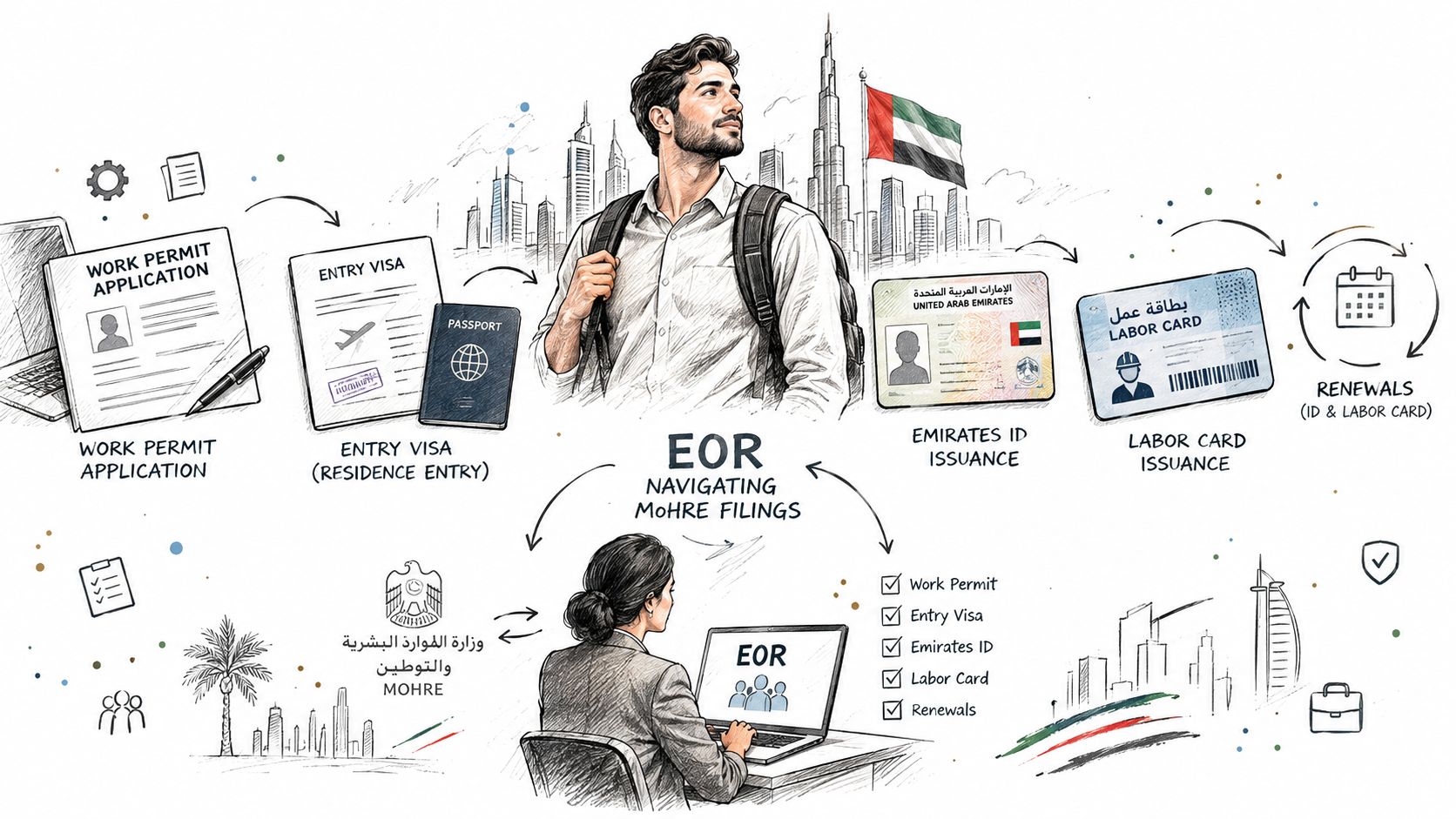
Visa administration can fail when the hiring company treats it as a back-office task. The sponsor determines who can lawfully employ the worker, which authority receives the application, and whether the employee can remain in the country under the new arrangement.
Renewals need the same discipline. HR teams should track document expiry dates, contract changes, transfers, and cancellation requirements. A worker moving from an ordinary free zone to mainland employment may need a new authorization route rather than a simple internal transfer.
A practical Dubai work visa application guide can help candidates and hiring teams understand the document journey. The EOR remains responsible for coordinating the employer-side process, but the employee still needs to provide accurate information and complete required steps.
Immigration checkpoint: Never treat a signed offer as proof that the employee can start work. The sponsor, authority, permit status, and payroll setup must align first.
UAE payroll costs change materially according to the employee's nationality and the applicable employment regime. A finance team that models only gross salary and the EOR service fee can understate the true employer cost.
For UAE and GCC nationals, employer social security contributions apply. Expatriate employees generally don't trigger employer social security withholding, according to the KPMG UAE tax and social security guide.
For UAE nationals, the standard employer contribution is 12.5% of gross salary, increasing to 15% for public-sector employers. Employees contribute 5% to the GPSSA, under the same source. Payroll models should therefore classify nationality and emirate before finance approves a hiring budget.
A useful model separates the employment cost into distinct layers:
Contractual pay: Basic salary, allowances, bonuses, and other agreed compensation.
Employer statutory costs: Applicable social security contributions based on nationality and employer category.
End-of-service obligations: Gratuity or the relevant free-zone savings arrangement.
Payroll and administration: EOR fees, payment processing, document handling, and ongoing support.
Immigration costs: Visa, permit, identity, and renewal administration where the arrangement requires sponsorship.
The distinction between basic salary and total remuneration matters for gratuity. For most UAE employees, end-of-service gratuity becomes mandatory after at least one year of continuous service and is calculated on basic salary only. The formula is 21 days per year for the first five years, then 30 days per year afterward, subject to a cap of two years' total remuneration. Those rules are summarized in this UAE EOR gratuity guide.
DIFC is a notable exception because it uses the funded DEWS savings scheme instead of traditional gratuity, creating a separate compliance and funding model. A payroll team should never apply the mainland gratuity formula automatically to a DIFC employee.
Under Federal Decree-Law No. 33 of 2021, the employer must pay departing workers all wages and other entitlements within 14 days of the contract end date, according to the official UAE legislation. The EOR should calculate the final settlement, confirm deductions, process cancellation steps, and preserve the supporting records.
Companies reviewing global payroll administration should make nationality, emirate, authority, basic salary, and termination timing mandatory payroll fields. Those details protect the budget and reduce the chance of an incomplete final settlement.
The best way to evaluate an EOR is to test it against the actual hiring situation. Three companies can all describe their plan as “hiring in the UAE” while needing different legal and operational solutions.
A startup wants to hire a Dubai-based developer but doesn't yet have a UAE subsidiary. The candidate will work from a mainland location and report to a product team outside the country.
The EOR first confirms that its licensed entity can sponsor the worker and register the employment through MoHRE. It then issues the compliant employment contract, coordinates the work authorization and identity process, and activates WPS-aligned payroll.
The startup controls the developer's tasks and performance. The EOR controls the formal employment record, salary disbursement process, and statutory administration. The startup's finance team should budget separately for salary, applicable statutory costs, visa administration, and the EOR fee.
A consultancy wants a UAE-based national consultant operating through a free-zone structure. The company assumes the hire will cost the same as an expatriate employee because the role and salary are identical.
That assumption is unsafe. UAE and GCC national social security obligations can create a different employer cost stack, so the provider must classify nationality before the contract is finalized. The team also needs to confirm whether the free zone applies federal employment law with zone-specific administration or operates under a separate statute.
The EOR's checklist should include the correct authority, GPSSA treatment where applicable, payroll registration, benefits, and end-of-service handling. The client should request a written cost schedule rather than relying on a standard expatriate quote.
A distributed creative agency wants to hire a designer connected to ADGM. The designer may work inside or outside the UAE, and the agency wants the contract to reflect a remote arrangement.
ADGM updated its employment regulations in 2025 to recognize remote employees who can work inside or outside the UAE. The rules require employers to specify remote status in the contract, provide equipment, and address permits and visa obligations, as reported in this coverage of ADGM remote-work rules.
The arrangement still needs careful review. A remote worker may require a work permit and, where applicable, a residence visa and health insurance. The agency must also define work location, equipment responsibility, and the authority governing the contract.
Companies comparing employee and independent engagements can review Contractor of Record structures, but the worker's real relationship and immigration needs should determine the model.
Provider selection should begin with legal capability, not a polished dashboard. The relevant question is whether the EOR can employ this specific worker, in this specific location, under this specific authority.
A provider may support mainland employment but lack direct experience with ADGM or DIFC. Another may process payroll through a free zone but lack the sponsorship capacity needed for a worker who requires residence authorization. The buyer needs evidence, not a generic country list.
Ask for the employing entity. The provider should identify the legal entity that will sign the contract and explain its license and sponsorship authority. If the answer is vague, the arrangement deserves further review.
Test jurisdictional coverage. The provider should explain how it handles MoHRE, ordinary free zones, DIFC, and ADGM. A capable team will ask where the worker sits before presenting a contract.
Review payroll controls. The buyer should understand WPS processing, salary payment rails, approval cutoffs, corrections, and audit records. Payroll accuracy depends on process ownership, not just software.
Examine offboarding. The contract-end process should cover final wages, gratuity or DEWS treatment where applicable, visa cancellation, document retention, and the UAE's settlement deadline.
Guidance on understanding how EORs work can help procurement teams create a broader evaluation checklist. The final review should still be UAE-specific.
ADGM's 2025 remote-employee rules change the decision for some employers. They recognize remote employees working inside or outside the UAE and require contract language covering remote status, equipment, and permit or visa responsibilities.
That flexibility may reduce demand for an EOR in narrow cases where an employer can use an ADGM-regulated structure directly. It doesn't remove the need for compliant employment infrastructure. The key question shifts from “Does the company need an EOR?” to “Which authority governs the worker, and who is responsible for the employment obligations?”
A company planning distributed hiring can use remote hiring guidance to compare location, worker classification, sponsorship, and payroll requirements before selecting a provider.
An EOR can help an international company hire in the UAE without immediately creating its own local subsidiary. The arrangement works only when the provider's legal entity, sponsorship capability, contract, payroll route, and jurisdiction all match the worker's circumstances.
The main decisions can be reduced to a practical checklist:
Map the worker's location. Determine whether the role sits under mainland, an ordinary free zone, DIFC, or ADGM rules.
Verify the EOR entity. Confirm the license, sponsorship authority, and ability to employ in the relevant jurisdiction.
Separate employment from management. The EOR handles formal employment obligations while the client directs daily work.
Build the full cost model. Include salary, nationality-based social security, gratuity or DEWS treatment, immigration, payroll, and provider fees.
Plan the full lifecycle. Cover onboarding, WPS payroll, renewals, contract changes, termination, final settlement, and visa cancellation.
Review remote arrangements carefully. ADGM's updated rules may support flexible employment, but remote status doesn't automatically remove permit, visa, insurance, or equipment obligations.
A pilot with a small hiring group can expose weaknesses before a broader rollout. The company should request sample contracts, payroll calendars, escalation procedures, settlement calculations, and jurisdiction-specific onboarding requirements.
Local legal and tax advice remains valuable for unusual roles, regulated industries, transfers between zones, and national workforce obligations. Candidates and hiring managers can also use Our Job Tracker Chrome Extension to capture roles and organize hiring workflows while the legal and payroll review proceeds.
For organizations comparing UAE employment options with broader international hiring needs, We Are Distributed provides global employment advisory covering EOR, global payroll, Contractor of Record arrangements, contractor conversion, and international hiring structures. The next step is a jurisdiction review with the candidate's location, nationality, visa status, employing entity, and intended start date documented before the offer is finalized.
Companies planning a UAE hire should document the worker's location and employment status, then request a jurisdiction-specific EOR assessment before signing an offer or promising a start date. That review can prevent sponsorship delays, incorrect payroll setup, and costly end-of-service corrections.