Orchestration over policy, compliance captured at source, engagement models compared — how to run a distributed workforce once the first hires are already in place.

The most popular advice about global workforce management is also the least complete.
It usually starts with choosing an EoR, issuing compliant contracts, and setting a policy for remote work.
Those steps matter, but they don't manage a workforce once skills, priorities, locations, and legal conditions begin to change.
A globally distributed company needs more than a hiring vehicle and a policy library. It needs an operating model that helps managers reallocate people and capabilities across borders without losing visibility, control, or compliance.
Global hiring is often treated as a sequence with a clear finish line. A company identifies a country, selects an EOR, hires an employee, and moves on to the next market.
That approach works for an isolated hire, but it breaks down when the business must continuously adjust who works on which priorities, in which location, and under which engagement model.
The central question isn't whether a person can be hired legally. It's whether the organisation can keep making sound allocation decisions after the hire is complete.
A product team may need a specialist in another region. A customer success group may require additional language coverage.
A contractor may become strategically important enough to justify conversion. A project may need people working across time zones, while local employment rules restrict how the work is structured or recorded.
A policy can define approval routes, working hours, leave principles, and permitted locations.
It can't tell a manager which skills are available, whether a proposed move creates a tax concern, or whether the worker's current arrangement still fits the role.
That gap is why global workforce management should be treated as dynamic orchestration, not static administration. The operating model must connect workforce planning with employment advice, data capture, role design, and day-to-day tracking.
Values-based hiring remains useful because it helps a company select people who can operate with autonomy and clarity. However, values-based hiring should sit inside a broader system that continues to assess capability, location, engagement status, and business need after recruitment.
Annual planning still has a place. Finance teams need forecasts, leaders need headcount visibility, and people teams need a controlled approach to expansion. The weakness appears when annual plans become the only mechanism for deciding where work happens.
A more resilient model gives managers a current view of:
Available skills: Which capabilities exist, where they sit, and whether they can be reassigned.
Employment constraints: Which locations, entities, contracts, and worker classifications affect a proposed change.
Capacity and time zones: Who has room to take on work and where handovers could create delays.
Evidence quality: Whether location, time, pay, and engagement records are complete enough to support a decision.
Practical rule: A compliant hire is an event. Global workforce management is the system that governs everything after that event.
The companies that handle distributed growth well don't remove every local difference. They make those differences visible early enough for managers to act on them.
Global workforce management combines workforce planning, employment compliance, payroll, time and location data, skills visibility, and operational decision-making. It isn't limited to recording hours or approving leave.
The practical task is to coordinate people, skills, and technology across jurisdictions while preserving a defensible record of how work is organised.
That requirement became more important as distributed work moved from an emergency response to a durable operating pattern.
A 2025 academic review reported that the global share of remote workers rose from a probable pre-pandemic baseline of about 5% to 7.9% in 2019 to around 72% in September 2020, then 74% in December 2020, before easing to 45% in 2022.
By fall 2023, the review found that 12.7% of workers globally were fully remote and 28.2% were hybrid, showing that distributed work remained structurally significant after emergency restrictions ended. These figures are reported in the Deloitte workforce management review.

A conventional organisation chart describes reporting lines.
It doesn't show which skills can be redeployed, which roles require local employment advice, or where a project handover may fail because of time-zone separation.
A network view adds those operational dimensions. Each worker has a set of capabilities, a legal relationship with the business, a working location, a time-zone context, and a capacity profile. Managers can then evaluate a proposed change against both business needs and employment constraints.
Global workforce management differs from traditional annual planning:
Annual planning sets intended capacity. Orchestration adjusts capacity as priorities change.
A headcount plan counts roles. Orchestration maps skills to actual work.
A policy describes permitted behaviour. Orchestration records what happened and why.
A payroll run confirms payment. Orchestration creates the source data that makes payment and reporting defensible.
The commercial market reflects the scale of this operational problem. Industry estimates place the worldwide workforce management market at USD 8.9 billion in 2026, projected to reach USD 17.5 billion by 2033 at a 10.2% CAGR.
Another forecast places it at USD 13.09 billion in 2026 and **USD 34.46 billion by 2034 at a 12.86% CAGR.
North America represented 37.7% of the market in 2025. These estimates and projections are summarised by Yomly's remote work statistics and workforce management market overview.
A useful operating system doesn't merely accumulate data. It places the right information in front of the person making the decision.
A manager considering a cross-border reassignment needs to know whether the worker has the required skill, whether capacity exists, whether the proposed working pattern is permitted, and whether the organisation can capture the resulting time and location evidence.
People operations then needs a workflow for reviewing the change, updating the relevant records, and escalating specialist advice where necessary.
The practical implication is straightforward. Adaptability depends on connected records, not on faster policy writing.
A company that links its talent data, engagement data, payroll process, and advisory workflow can make quicker decisions without treating compliance as a final inspection.
That operating discipline is the foundation of workforce advisory and tracking support, particularly when the organisation expects roles and skills to move more often than its formal planning cycle.
Cross-border compliance fails when the organisation tries to reconstruct reality at the end of the month. Payroll can show what a worker was paid, but it may not explain where the work was performed, which entity employed the person, or whether a temporary assignment changed the reporting position.
The source workflow must capture the facts while work is being planned and performed.
Deloitte's cross-border HR compliance guidance identifies the need to reconcile employee identity, residence status, employing entity, gross compensation, telework rate, temporary assignment days, and supporting evidence for reporting in jurisdictions such as Switzerland and France.
The relevant requirements are set out in Deloitte's cross-border HR compliance and payroll guidance.
A design that stands up to scrutiny begins with a clear data model. The worker's identity should connect to the employing entity, contractual relationship, approved work locations, and relevant residence information.
The system should also preserve the dates and approvals associated with temporary assignments rather than relying on recollection.
The essential fields include:
Identity and entity: Match the individual to the correct legal employer and payroll relationship.
Residence status: Record the information needed to assess the worker's personal and employment position.
Gross compensation: Connect pay data to the relevant period, entity, and engagement.
Telework rate: Track the proportion or pattern of remote work where it affects reporting.
Assignment days: Record temporary work in another location with dates and approval evidence.
Supporting evidence: Retain the source documents and decisions that explain the record.
The exact implementation will vary by country and worker type. The design principle doesn't change. A later payroll output should be the result of an auditable workflow, not the first time the business asks where work took place.
Time tracking isn't automatically a compliance solution. A login location may not prove the worker's tax residence, and a calendar entry may not establish where duties were performed.
Systems need defined rules for what counts as evidence, who can amend it, and when an exception must go to payroll, legal, or tax specialists.
A practical control might require a worker to confirm a planned location before a temporary move, while the manager approves the business need and the people team checks whether the arrangement changes the employment or reporting position.
The system should retain the original request, the decision, and any subsequent correction.
Compliance principle: Capture the decision trail, not only the final payroll number.
End-of-month reconciliation still has value, but it should identify exceptions rather than create the entire record from scratch.
A connected process can flag missing location information, unexplained assignment days, or a mismatch between the employing entity and the work arrangement before payroll closes.
For teams building the operating layer around global payroll support, the key evaluation question is whether the provider can accept and preserve the underlying employment data.
A payroll file without reliable source logic leaves the organisation exposed when an authority, auditor, or worker asks how the result was reached.
No engagement model is universally superior. The right choice depends on the role's strategic importance, the expected duration of the relationship, the worker's actual independence, and the legal environment in the country where the work occurs.
An EOR can provide a practical route for employing a full-time worker where the company doesn't have a local entity.
A Contractor of Record can support a genuine independent contractor relationship while handling parts of the administrative burden.
Direct entity establishment provides greater control, but it also creates a larger and more permanent local operating commitment.
| Model | Best for | Compliance burden | Speed to deploy |
|---|---|---|---|
| Employer of Record | Full-time employees in a market without the company's own entity | Shared with the EOR, while the company still owns role, conduct, and operational decisions | Usually faster than establishing an entity |
| Contractor of Record | Genuine freelancers and independent contractors requiring structured administration | The classification and working relationship still need careful review | Usually faster than direct employment |
| Direct entity | Sustained strategic operations with enough local permanence to justify an entity | The company carries direct responsibility for local employment, tax, payroll, and governance | Slower because setup and ongoing administration are required |
The most important decision isn't speed. It's whether the engagement model reflects the actual relationship.
A full-time role with close supervision, fixed responsibilities, and ongoing integration into the organisation may require an employment structure even if the worker prefers a contractor label.
A specialist engaged for a defined deliverable may fit a contractor arrangement, provided the facts support genuine independence and local rules allow it.
A company weighing internal hiring against other approaches should check out Vision's list of alternatives to hiring offshore talent to broaden the options under consideration.
The comparison should still return to role design, accountability, knowledge retention, and compliance rather than focusing only on headline cost.
Contract conversion deserves particular attention.
A contractor may become central to product knowledge, receive increasingly controlled instructions, or work continuously alongside employees.
Those changes can make the original arrangement less suitable. A regular review prevents the business from treating an old contract as permanent proof that the relationship remains unchanged.
The distinction between contracting and consulting also affects scope, control, and deliverables. Teams can use contracting versus consulting guidance to sharpen that assessment before selecting a hiring vehicle.
The legal environment for non-traditional work is also moving.
The International Labour Organization adopted a binding Decent Work in the Platform Economy Convention in June 2026, passed by 406 votes to 8, according to coverage of the ILO agreement.
The agreement requires human participation in decisions made by automated systems, including hiring, firing, and pay, and is framed as a response to a platform workforce estimated at up to 435 million online workers.
That development reinforces a practical rule for employers using automated workforce tools.
Automation can route information and identify exceptions, but human accountability must remain clear where systems influence engagement, compensation, or access to work.
Strategy becomes useful only when managers can execute it without switching between disconnected records.
A global workforce management stack should connect employment advice, worker data, role information, payroll workflows, time and location records, and the tools people use to identify opportunities.
The most important integration isn't always technical. It's the connection between a business decision and the evidence required to carry it out compliantly.
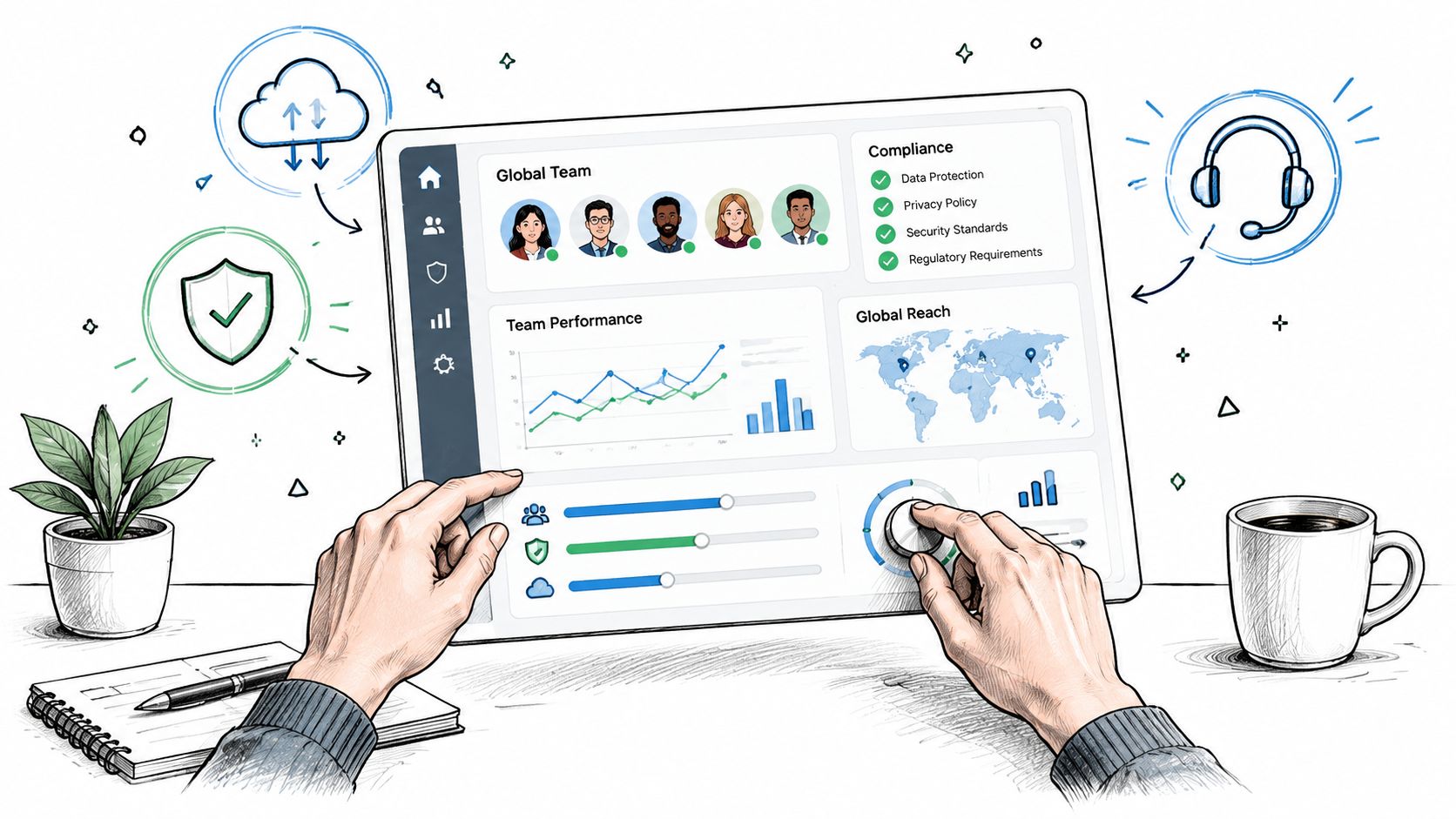
A company may need advice on EOR selection, global payroll, contractor conversion, total rewards, or changing providers.
That advice should feed directly into operational workflows, including worker records, approvals, payment instructions, and reporting evidence.
At We Are Distributed, we combine career management tools with global employment advisory. For businesses, that includes:
Employer of record & global payroll
Contractor of record and contractor conversion
Total rewards & switching EOR provider support
For workers, we offer a Global Job Board, AI Career Agent, Job Tracker Chrome extension, Resume Builder, and Career CRM.
The point isn't to place every workforce activity in one product.
The point is to reduce the distance between verified information and the decision that depends on it.
Employers need clear data about where talent can work and under what structure. Knowledge workers need visibility into roles, compensation, eligibility, and application progress.
Teams assessing AI workforce software should test whether automation preserves human review, exposes the source of each recommendation, and supports local differences instead of flattening them. A polished interface won't compensate for weak data ownership or unclear escalation routes.
A Job Tracker can help a worker capture roles from different sources, assess fit, and maintain consistent follow-up.
An AI Career Agent can use a person's profile and preferences to recommend roles and answer career questions.
These tools become more useful when they connect with employment guidance rather than treating eligibility as a separate research task.
The same principle applies to employers.
A skills record should support redeployment decisions, not only recruitment.
A location field should support compliance review, not only search filtering. A salary record should inform total rewards and negotiation, not merely appear in a job advert.
For a practical view of contractor payment considerations, teams can consult guidance on paying a contractor. The workflow should then connect the answer to classification, approval, invoicing, tax handling, and the evidence retained for the engagement.
A distributed employer expanding into a new region shouldn't rely on anecdotes from a single recruiter or a recent candidate conversation.
Labour supply, job quality, inequality, compensation expectations, and employment conditions can move in different directions, so workforce managers need comparable evidence before changing hiring or reward plans.
The International Labour Organization's Employment and Social Trends 2026 report says global labour markets remain broadly stable at headline level, while progress on job quality has stalled and inequalities are widening.
That combination matters to employers because a stable headline market can still contain retention pressure, uneven access to good work, and weaker confidence among particular groups. Additional findings can be found in the ILO Employment and Social Trends 2026 report.
Consider a distributed company planning to recruit in a new region. The leadership team initially sees a strong talent pool and assumes that an existing remote contract can be reused. People operations should pause before approving the role.
First, the team needs to establish whether the proposed work fits an employee or contractor relationship under local rules.
Next, it should identify the employing entity or suitable intermediary, confirm the expected work location, review pay and benefits expectations, and define how time and temporary travel will be recorded.
The company should then compare the region with existing markets using a consistent evidence base.
The OECD Employment Database covers all 38 OECD countries and provides labour force, employment, unemployment, and detailed indicator data.
That standardisation helps leaders distinguish a genuine market signal from a small sample of applicants.
The OECD Employment Outlook 2026 is an official cross-country publication focused on employment developments and prospects in OECD member countries.
It can support benchmarking decisions across major markets rather than leaving each country assessment to an isolated local report. The publication is available through the OECD Employment Outlook 2026.
A practical review should ask:
Talent availability: Does the market provide the skills required for the work, or only a broad supply of applicants?
Job quality: Will the proposed role offer clear progression, dependable support, and a credible total rewards position?
Operational fit: Can the team collaborate across time zones without shifting unreasonable meeting or handover demands onto one region?
Legal readiness: Can the organisation capture the records needed for employment, payroll, tax, and labour-law reporting?
Retention context: Are inequality and job-quality signals likely to affect trust in the employer's proposition?
The final decision shouldn't be “hire locally” or “avoid the market”. It should specify the engagement structure, operating requirements, evidence standards, and review points that make the expansion sustainable.
A workable roadmap starts with the current operating reality, not an idealised future state. The people team should map every worker by country, residence, employing entity, engagement model, role, working pattern, and payroll route. Missing fields should become visible risks rather than silent assumptions.
Review whether each worker record contains reliable location and entity information. Check whether temporary assignments, telework patterns, compensation, and supporting evidence reach payroll in a form that can be audited.
Then examine how managers request changes. A role reassignment, location move, contractor conversion, or new hire should trigger the right people, legal, tax, payroll, and finance reviews without forcing every decision through an informal message thread.
A global payroll or EOR provider should be evaluated against practical questions:
Coverage: Can it support the countries and engagement models the business uses?
Data capture: Does it accept source information about identity, residence, entity, work location, and assignments?
Auditability: Can the organisation see approvals, amendments, evidence, and exception handling?
Local execution: Does the provider distinguish local requirements rather than applying one global template?
Change management: Can the workflow handle contractor conversion, relocation, and provider switching?
Human review: Are consequential decisions escalated to qualified people instead of being hidden inside automation?
Finally, establish a recurring workforce review. Managers should assess changing skills, capacity, locations, and role requirements, while people operations checks whether each proposed move remains compliant and properly recorded.
Operating standard: The roadmap is complete when the company can move talent quickly and explain every material decision afterwards.
That shift turns global workforce management from a collection of country policies into a living operating system. Companies that build the data, advisory, and tracking layers together can redeploy capability with less friction while keeping local obligations visible.
Distributed employers can start by auditing their worker records, engagement models, and time-location workflows this week. For practical support comparing global employment options, payroll routes, contractor arrangements, and career tracking tools, contact us.