What an AI resume builder actually does to your CV — parsing, prompts, ATS survival, privacy trade-offs and the checks to run before you upload.

Updating your CV to compete in the global marketplace can feel hopeless. One employer wants a one-page resume, another uses legacy portals that make you repeat personal information three times to apply, and a third expects wording that fits a specific market.
A good AI resume builder can speed that up, but also creates problems of its own with a 'polished', yet generic document that doesn't parse well in an ATS, or reveals more personal data than it should.
Sure, AI is fast. But can it help global candidates differentiate themselves with a clearer, better tailored CV, without losing their own voice.
A remote candidate in Berlin, Lagos, or São Paulo can spend half a day reshaping one CV for every job only to be rejected before a human opens the file.
Timing matters more than ever, because job applications are now filtered, compared, and ranked before a recruiter gets involved. Tailoring is no longer optional, especially across markets where CV length, wording, and evidence of impact vary. A global applicant also has to think about local norms, not just the job description.
First, volume has gone up.
Candidates are sending more applications than ever before, and many are using AI to do it faster.
In a 2026 resume industry report, 42.6% of Americans said they used AI tools the last time they updated their resume, 7.5% let AI write most or all of it, and 27.1% submitted a fully AI-generated resume without edits, showing how normal AI-assisted CV creation had become in the U.S. job market by mid-2026 (Novorésumé resume report 2026).
Second, ATS filtering is ruthless. If your resume cannot be parsed, your efforts are wasted.
Third, cross-border tailoring is harder than many job seekers admit, because different markets reward different signals, and a one-size-fits-all CV flattens those cues.
The tool is useful only if it helps a candidate move from blank page to a CV that still reads like a real person wrote it.
That is why the best use of AI here is not “write it for me”. It is “help me draft faster, tailor smarter, and keep control over how I sound.” For global job seekers, that trade-off is the whole story.
A good AI resume builder usually does three jobs in one flow. It reads existing CV text or prompt inputs, turns them into structured fields, and rewrites or generates bullets that are easier to scan and match. Many tools today however, simply parse those bullets against a target role so the output reflects the posting rather than a generic career story.
Whilst well meaning, this approach can often lead to rejections at even higher rates. Why? Because the employer has received 300 applications that also do the exact same thing.
Parsing is the first step. The tool breaks your CV into sections such as experience, skills, and education, then rebuilds the structure so the content can be edited cleanly. Generation comes next, where a language model rewrites rough notes into polished bullets.
A raw input like, “managed a sales team across EMEA for 3 years,” can become a stronger bullet if the tool is given enough context. A better output would be something like, “Led a 12-person EMEA sales team, growing regional pipeline by 34% over three quarters.” The point is not the number itself, which has to be real, but the shape of the rewrite, scope, team size, region, and outcome.
Keyword matching is the last layer. The builder looks for language in the job description and nudges the CV toward those terms where they fit naturally. That is why some tools feel like simple form fillers and others feel more like drafting assistants.
The difference between template-only and LLM-driven tools matters. Template-based builders mainly reformat content. True AI builders generate language, but they're only as good as the prompt, the model, and whether the tool keeps your original meaning intact instead of replacing it with corporate filler.
A useful mental model is this.
Good AI resume tools don't invent your value. They translate it into the language recruiters and ATS systems can read.
If the tool cannot do that without flattening your experience, it's not helping enough.
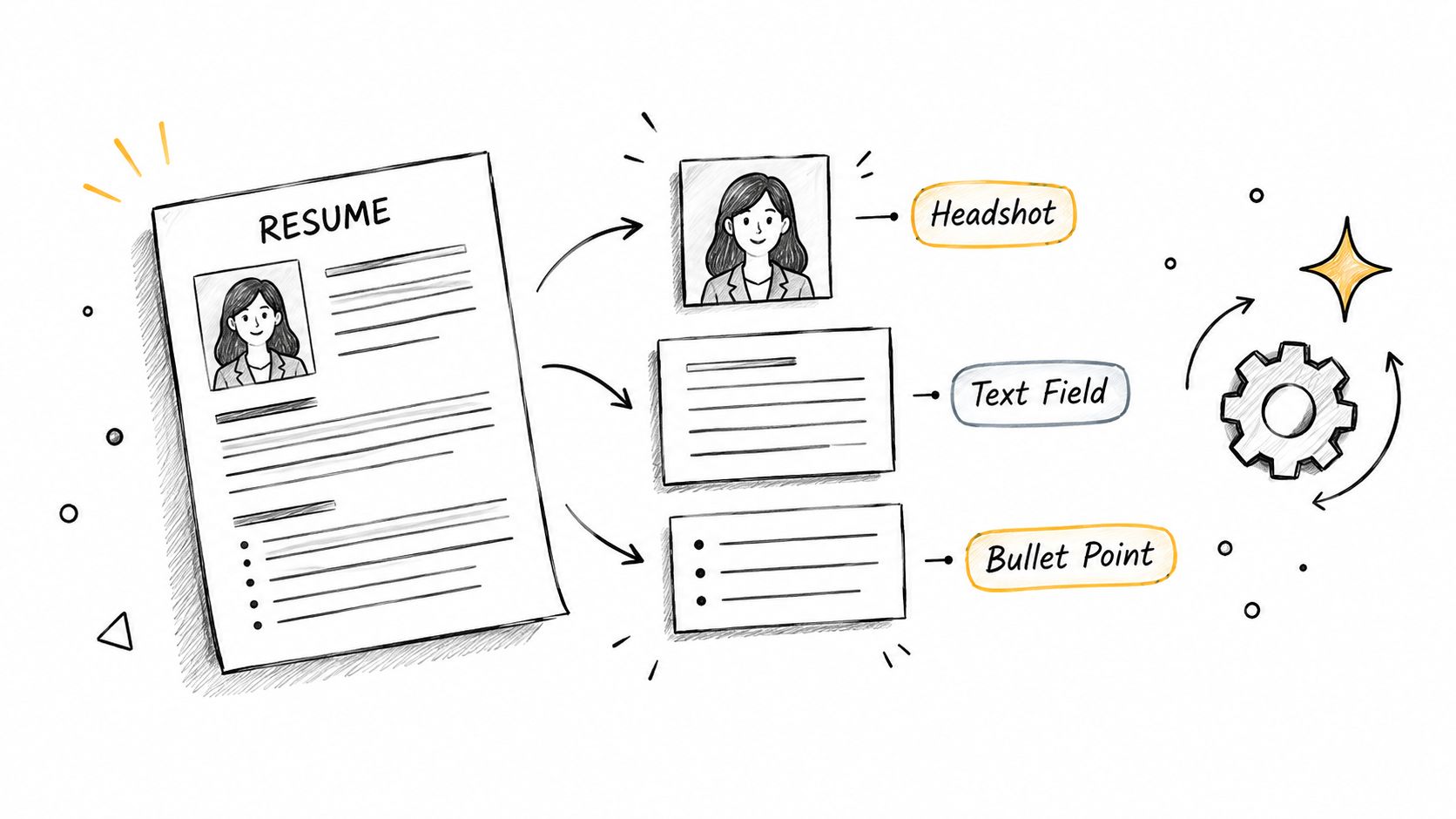
For a practical example of how profile data gets turned into something more usable, a service like LinkedIn photo creator for professionals shows how AI products often start by structuring identity before they generate content.
The case for an AI resume builder is simple. It gets a first draft done fast, forces structure onto messy experience, and makes tailoring less painful. For someone applying across time zones and markets, that matters.
The downside is just as clear.
AI output often sounds familiar in the worst way, and recruiters notice. In 2026 coverage, 49% of hiring managers reported dismissing resumes they suspect are AI-generated, while other surveys found 74% had encountered AI-generated content in applications and 58% were concerned about it (HiredKit 2026 coverage).
Speed is the obvious gain. A candidate can turn a rough history into a working draft in minutes instead of staring at a blank page. Clean structure is another real advantage, because a builder can standardise headings, spacing, and ordering in a way that makes the CV easier to review.
Tailoring is the bigger benefit. A strong resume builder helps each version reflect the job, which matters because generic applications get ignored.
The report cited in 2026 resume statistics found that people who send the same resume everywhere were 3 times more likely to get zero interview invites than applicants who customise for every application, with zero-invite rates of 20.5% versus 6.4% (Novorésumé resume statistics).
The same source said manual tailoring slightly outperformed AI tailoring per application, with interview rates of 17.5% versus 15.5%.
The obvious danger is generic phrasing. The quieter danger is loss of personal voice, that gets worse when the tool flattens regional CV conventions or handles non-Latin scripts poorly.
Global applicants need their CV to sound native to the market they're targeting, not auto-translated into blandness.
Formatting risk is also real.
Independent testing of AI resume builders found that visually polished templates failed parsing 30% to 45% of the time, while more resilient single-column or structure-preserving outputs parsed reliably across systems such as Workday, Greenhouse, Lever, and Taleo, with 88%+ reliability for the better-performing products (ATS verification testing 2026).
The verdict is straightforward. An AI builder is worth it when the candidate has enough real material to edit, enough volume to justify automation, and enough discipline to cut the fluff. It is a bad fit for senior roles that depend on narrative, precision, and proof of judgement. The next step is judging the tool before it gets access to any of the candidate's data.

A good AI resume builder has to pass a basic test before it earns trust. The first is whether the output parses cleanly in real ATS systems. The second is whether the tool handles language, exports, and data in a way that suits cross-border applications.
Start with a real CV, not a sample.
Upload the version that already has your honest work history, then test whether the layout survives copy-paste into common application systems. If the builder only looks good inside its own interface, it's not good enough.
Check language and locale support next. Global candidates should not accept tools that work well only in English if they're applying across multilingual markets. Export formats matter too, because DOCX, PDF, and plain text each serve a different purpose. A builder that traps the candidate inside one format creates friction later.
Data handling is the biggest trust question. For an internal comparison point, our Resume Builder sits inside a broader job-search workflow, so applicants can treat CV creation as part of a wider process rather than a standalone upload.
Practical rule: if the privacy language is vague, the builder is probably not ready for sensitive data.
Now look for red flags. Vague model descriptions are a problem. So is the absence of a delete option, or pressure to upgrade before a usable export is available. A tool should explain whether uploads are retained, whether they're used for training, and whether any subprocessors can access them.
| Question to ask | What a good answer looks like | Red flag |
|---|---|---|
| Where is the data stored? | Clear region or hosting explanation, with cross-border handling described | “We use industry-standard systems” and nothing else |
| Can the data be deleted? | A visible delete flow or written deletion process | No deletion path at all |
| Is uploaded content used for training? | A direct yes or no, plus user controls where relevant | Silence or buried wording |
| How long is content retained? | A specific retention window or account-based rule | “Kept as long as necessary” with no detail |
| Is there a DPA for EU or UK applicants? | A named policy or contract path for business use | No mention of regional compliance |
| Which export formats are available? | DOCX, PDF, and plain text clearly supported | Export locked behind payment or only one format |
| Does it parse cleanly in ATS tools? | A clear explanation of structure-preserving output | Pretty templates with no parsing evidence |
The final filter is blunt. If the answer to this question is no, the tool is not ready yet, would I be comfortable if a recruiter saw this output unedited?
A good prompt makes the difference between a usable bullet and a pile of polished nonsense. The strongest outputs from AI resume builders usually comes from giving the model role, scope, and measurable outcome, not from asking it to “sound impressive.”
Use this pattern. Role, scope, result.
The model needs enough context to keep the language anchored in real work. A weak input like “handled customer success” becomes sharper when it's rewritten with territory, account size, tooling, or business outcome, as long as those details are true.
A better prompt looks like this.
Role: “Customer success manager”
Scope: “Supported enterprise clients across APAC”
Outcome: “Improved renewal workflow and reduced response delays”
That can produce a bullet closer to the candidate's actual contribution instead of a vague claim. The same logic works for marketing, sales, operations, finance, and technical roles.
For job-specific adjustments, feed the builder a short snippet from the job ad and ask for language that mirrors the posting where it fits. The internal product marketing resume examples page is useful as a reference point for what a structure can look like in practice, especially when the role asks for outcomes instead of duties.
Do not ask the model to make everything “more professional” or “more impactful”. That usually produces the same vague filler every recruiter has seen before. It also encourages fake precision, which is worse than ordinary prose.
These habits are essential.
Edit every output: AI drafts the text, but the candidate owns the final wording.
Keep one human-written anchor sentence per role: A short line in the candidate's own voice helps the CV feel personal.
Strip invented metrics: If the number was never tracked, it doesn't belong on the page.
Read the plain-text version: Jargon and awkward repetition stand out quickly when formatting is removed.
The final aim is not novelty. It's fit. A strong prompt gives the tool enough structure to mirror the job ad without sounding like a copy machine.
A CV upload is a privacy decision, not a convenience choice. An AI resume builder can see work history, contact details, career gaps, and sometimes information that should never leave a local file.
A serious reader checks the privacy policy before uploading anything.
That is where you look for who can access the file, whether subprocessors are involved, and which jurisdictions may handle the data. GDPR standards do not automatically govern every platform, and cross-border hiring makes that gap matter.
The risk is not just storage. It is where the text flows next. Some platforms process a CV and stop there. Others route it through vendors, support tools, or model pipelines that sit in other regions. If the product does not spell that out clearly, treat the setup as opaque.
Ownership language also deserves scrutiny.
Consumer tools often blur the line between a candidate's document and platform-held content. If export, deletion, or transfer is awkward, the candidate does not really control the CV. That is a bad trade if the same document will be reused across multiple applications and countries.
The safest move is to upload a clean version and keep the sensitive material out of it. Leave out national ID numbers, home addresses, referee contacts, and any extra notes that do not help the application. If the platform does not need it, do not hand it over.
Strip sensitive identifiers: keep only the details the application needs.
Use a clean working version: remove private comments, drafts, and side notes before uploading.
Check where the file can travel: read for subprocessors and data transfer language, not just marketing copy.
Confirm who can touch it: look for clear wording on access, review, and support handling.
Confirm deletion and export paths: the controls should be practical, not buried in vague terms.
Remote hiring adds another layer because legal handling of employment data varies across jurisdictions, and remote work increases the cross-border complexity around hiring and work arrangements (global remote work legal implications paper). Treat the upload box as a temporary workspace, then keep the record under your control.
A builder works best when it sits inside a proper job-search system. It should not be the whole strategy. The candidate still needs role selection, editing discipline, outreach, and tracking, or the process turns into fast but unfocused application spam.
Start by pulling a short list of target roles from job boards and employer pages. Feed the full job description into the builder alongside a master CV, then generate one draft per role. After that, the candidate edits for voice, accuracy, and evidence.
The handoff matters. A CV is only one asset. The same core content should shape the cover note, the LinkedIn refresh, and the tracker entry, otherwise the search fragments.
Our job application tracker app fits naturally here because a good workflow needs a place to record what was sent, to whom, and in what version.
For broader interview prep, candidates often pair CV tooling with AI interview assistant options once the application starts getting responses. That makes sense, because the same evidence used in the resume has to hold up in conversation later.
A weak draft says, “responsible for stakeholder communication and supporting projects across regions.” It sounds safe and forgettable.
A better human-edited version says, “Led stakeholder updates across APAC launches, aligned timelines between product and operations, and kept delivery on schedule.” The difference is not style alone. It's accountability, geography, and action.
A good AI resume builder is a drafting partner, not autopilot. Use this checklist before you send anything out.
Accuracy: every role, date, title, and metric matches your source CV or LinkedIn, with no invented achievements
Authenticity: read the summary aloud. If you cannot hear your own voice in at least two lines, rewrite them
Privacy: remove passport numbers, full address details, and other sensitive identifiers, then check whether the builder stores uploads beyond the session
Fit: export the PDF, run a quick ATS check, and confirm the file still reads cleanly in the preview
Workflow: log the version, target role, and recruiter contact in a job search tracker before you apply.
If the draft overclaims, sounds generic, or exposes data you would not share in an email, it is not ready. Keep the final call with the candidate.