How to fit a resume on one page without losing proof — what to cut first, layout tactics that buy space, and when two pages win.

A recruiter opens a resume for a remote role whilst answering Slack messages from team members across 9 time zones. The candidate has relevant experience, but the document runs across 3 crowded pages.
Another candidate has a polished one-page resume, yet half the evidence is missing. Both have made the same mistake: treating page count as the gold standard to meet for application success, instead of value and impact.
For distributed knowledge-work roles, a one-paged resume can signal focus, but only if the page carries a coherent story. Longer resumes can show depth, but only when the second page earns its place.
The right length depends on experience, relevance, role complexity, and how clearly the candidate's value appears at a glance.
A recruiter comparing candidates across time zones may favor a one-page resume for speed, then spend longer with a two-page document that proves deeper ownership. Page count is a strategic choice, not a universal rule.
Recruiter research recorded a clear shift in preference.
A 2019 study found recruiters were 2.3 times as likely to prefer two-page resumes over one-page resumes, while respondents two decades earlier preferred one paged resumed by 3:1 margin.
The same study recorded about 2 minutes and 24 seconds reviewing one-page resumes, compared with 4 minutes and 5 seconds for two-page resumes. (ERE's recruiter research on resume length)
Recent survey data supports that split. A 2025 survey of 1,013 HR professionals found that 82.1% considered one or two pages ideal overall. About 31% specifically preferred one page, while 51% preferred two pages. (The survey summary on ideal resume length)
Use one page when your strongest evidence fits without shrinking the type or deleting relevant outcomes. Choose two pages when the second page adds scope, progression, or proof that a distributed role requires.
Oxford advises keeping a CV to one or two full pages in most cases, while noting that academic CVs can be longer and some employers, including investment banks, expect one page. (Oxford's CV guidance)
| Experience level | Recruiter preference or guidance |
|---|---|
| Overall recruiter preference | About 31% prefer one page, while 51% prefer two pages |
| General CV guidance | One or two full pages in most cases |
A single page can make location, time-zone overlap, tools, and outcomes easy to find. Two pages can show cross-team ownership, international collaboration, or distributed systems work that would look thin after aggressive editing. Cut repetition, not proof.
Use resume builder to organise career information before deciding what belongs on the submitted resume. Use one page when it creates clarity, not when it creates omissions.
A one-page edit should remove low-value content before it removes proof. Candidates often cut a strong achievement while keeping a vague profile, a long address, and a list of soft skills. That is backwards.
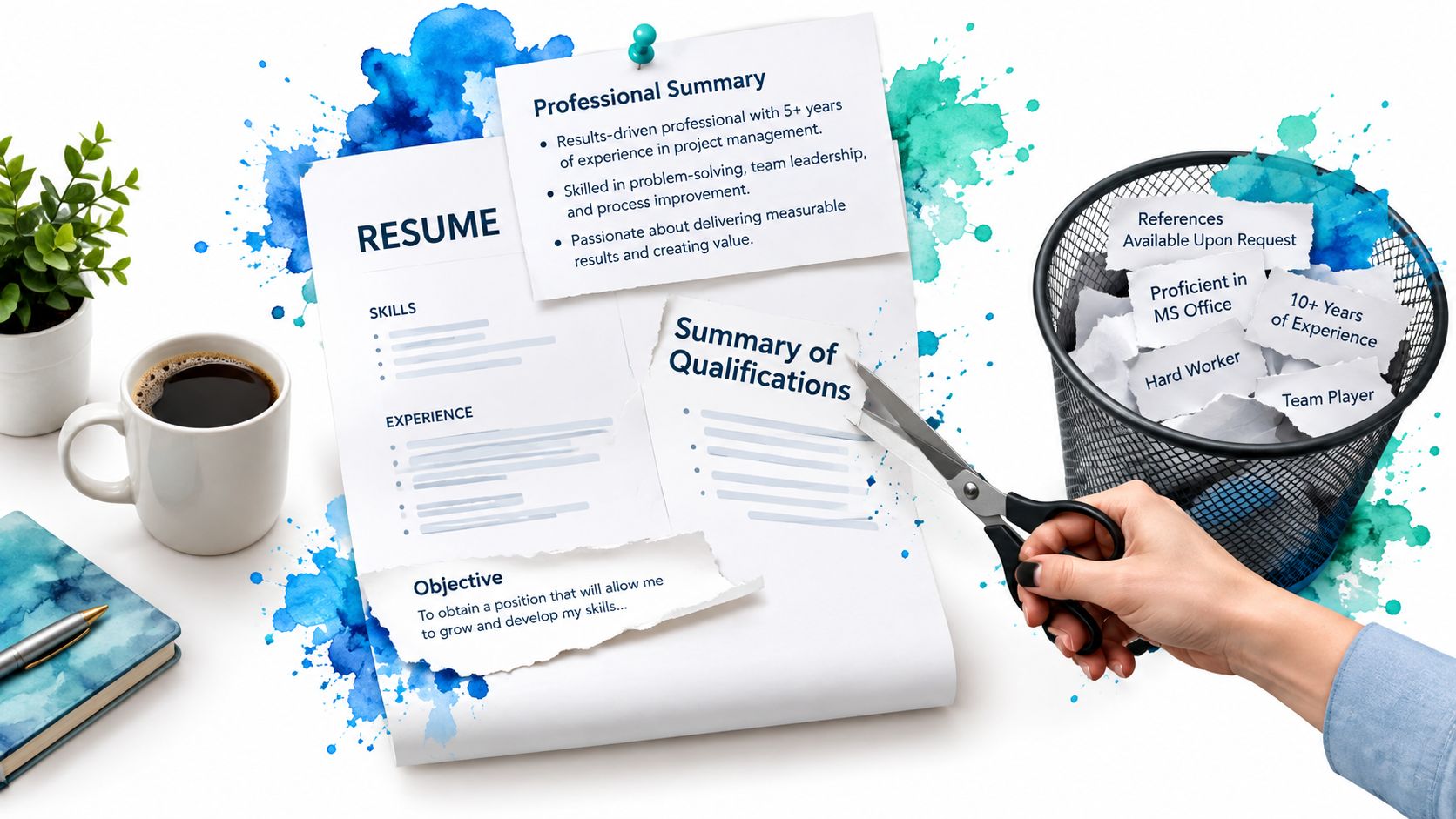
Remove the objective statement. Replace it with a sharp three-line summary that names the target role, the value offered, and one credible proof point. A summary should orient the reader, not announce that the candidate wants an opportunity.
Compress older experience. Roles older than ten years usually deserve less space unless they directly support the target role. Early-career positions can become one line with the title, employer, dates, and one merged achievement bullet.
Cut soft-skill claims. “Excellent communicator”, “team player”, and “detail-oriented” are not evidence. Glasgow's one-page CV guidance recommends using bullets, focusing on achievements, keeping job descriptions concise, and removing material such as referees or “available on request”. (The University of Glasgow's one-page CV editing guidance)
Merge redundant bullets. Each surviving bullet should combine an action, a relevant tool, and an outcome where the evidence exists. “Managed reporting” is weak. “Built reporting in Looker, helping product teams identify recurring activation issues” carries more information without inflating the claim.
Audit the skills block. Keep tools, certifications, languages, and methods that support the specific vacancy. Drop outdated software, unrelated hobbies, references, and a full street address. A city or region and a professional contact line are enough for many global applications.
Candidates can sharpen sentence structure with practical tips for concise writing, especially when bullets contain repeated context. The aim isn't fewer words for its own sake. It's more relevant evidence per line.
A purpose-built document can also help candidates organise role-specific content. Our resume builder comes with a resume template built-in for success. Instead of providing 50+ templates, colours and graphics like many alternatives; ours only contains 1.
However, it was designed based on the leading factors that result in interviews and job offers. So you can spend less time on changing colours and fonts - and more time on showcasing why you're a top candidate.
Layout should create breathing room, not disguise weak editing. A page that looks crammed tells the recruiter that the candidate couldn't decide what mattered.
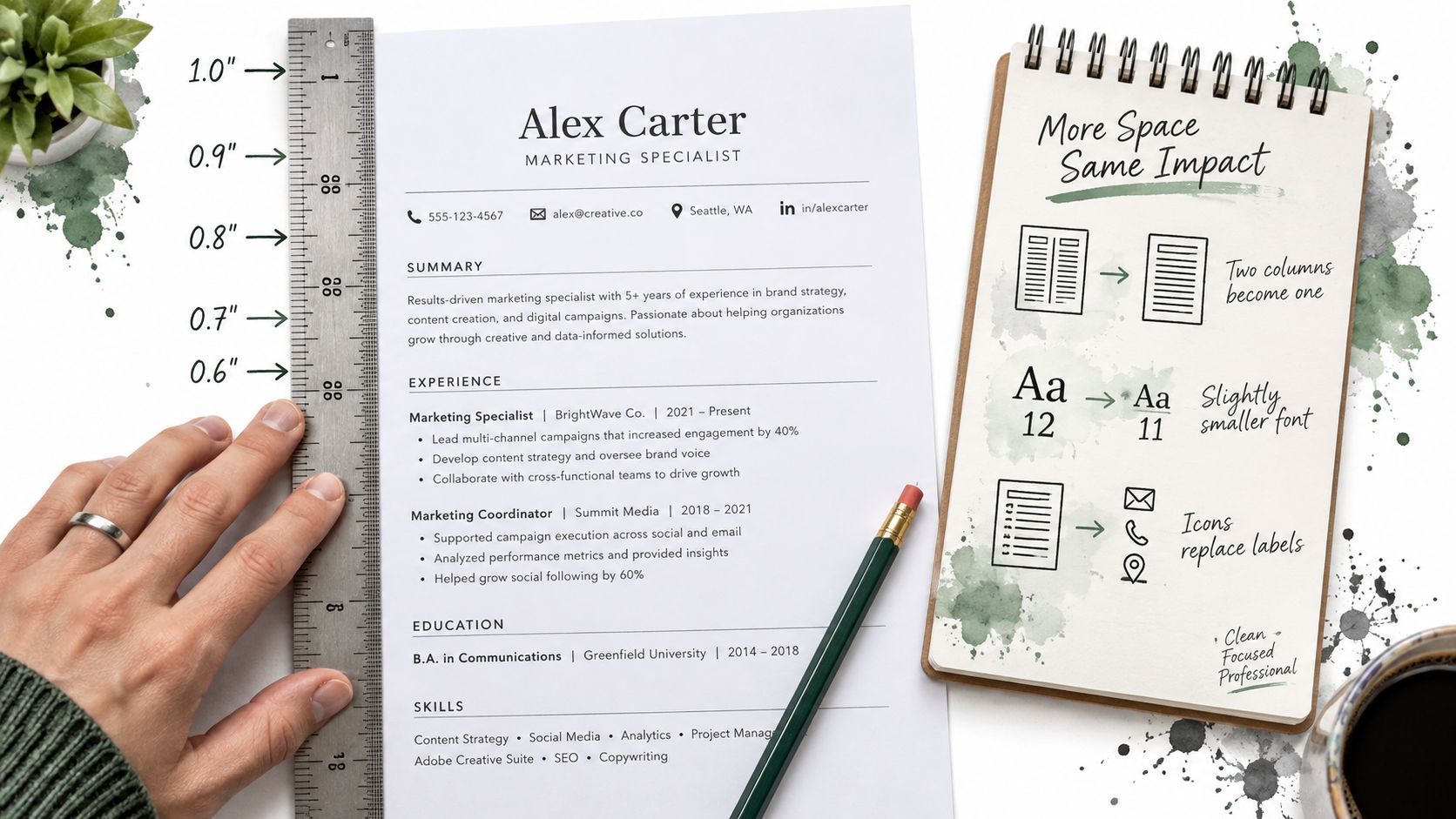
Start with margins. Reducing margins from one inch to 0.6 inches on each side can recover meaningful room, but margins should still protect readability and printing. Never solve a content problem by pushing text to the edge of the page.
Use a readable body font at 10.5 to 11pt, such as Calibri, Source Sans, or Inter.
The candidate's name can sit at 13 to 14pt. Going below 10pt is a poor trade. Recruiters may forgive a second page more readily than microscopic text.
Section order matters because remote hiring managers often scan from the top down. Candidates with more than two years of work history should generally put experience before education.
The header should make the candidate's location or working region, professional email, portfolio or LinkedIn profile, and remote-work relevance easy to find.
Replace paragraph-style descriptions with tight bullets, ideally limited to two lines when the evidence allows it. Lead with a strong verb and finish with a result, measurement, scope, or concrete deliverable.
A technical candidate may use a two-column skills block when the role explicitly requires many tools. For broader roles, a single comma-separated list is usually cleaner and less likely to confuse ATS parsers across different hiring systems.
Decorative design is usually a distraction.
Photos, icons, coloured sidebars, text boxes, and elaborate graphics can reduce parsing accuracy and add little value for distributed hiring managers.
Standard headings, consistent spacing, and conventional bullet points travel better across countries, devices, and recruitment platforms.
Practical rule: if a layout trick makes the resume harder to copy, parse, print, or read on a small screen, cut it.
A junior data analyst in Singapore may have two internships, an academic project, and Coursera certificates.
A mid-career product marketer in Lisbon may have eight years of experience across five agency and in-house roles. Both can produce a credible one-page resume, but they need different compression decisions.
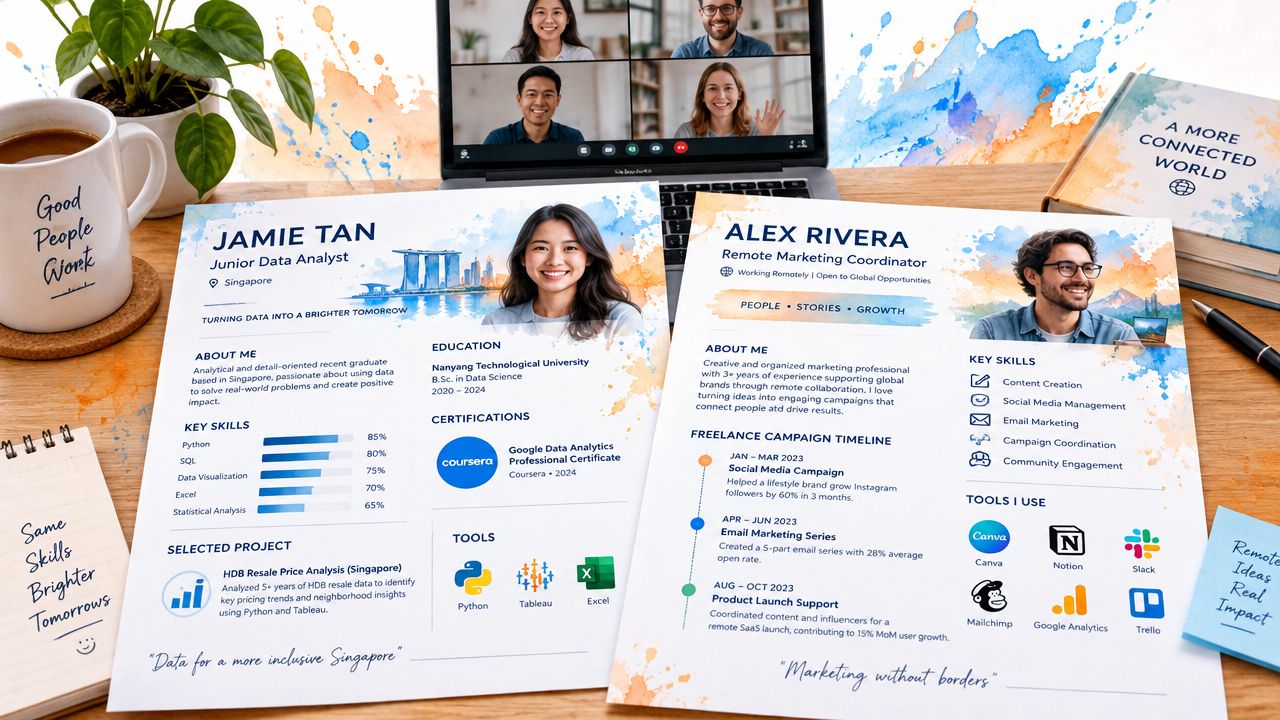
Before editing, the analyst has separate sections for internships, an academic project, certificates, tools, coursework, and a long summary. The page becomes a catalogue of activities rather than a case for analyst readiness.
The project belongs inside the experience block:
Weak: “Academic project involving analysis of customer data.”
Stronger: “Analysed customer data in Python and Excel, presenting retention findings to a project panel.”
The certificates can move to one line beneath education: Coursera certificates in data analysis, SQL, and visualisation. The skills section can become a hybrid list: Python, SQL, Excel, Tableau, data cleaning, dashboard reporting.
The result removes separate project and certificate headings, while preserving the tools and evidence most relevant to an entry-level analyst vacancy. Exact line savings depend on the template, but the structural saving comes from eliminating repeated headings and explanatory sentences, not from reducing the font.
The Lisbon-based marketer has five roles, including agency and in-house positions. The most recent two roles need detail.
Three earlier roles can become an Earlier roles line listing employers, titles, and dates, followed by one bullet containing the strongest relevant outcome.
Weak phrasing such as “Responsible for creating marketing campaigns and working with multiple teams” should be removed.
A tighter version is: Led cross-functional launch campaigns across product, sales, and creative teams, linking positioning work to measurable pipeline outcomes.
Each current role can include a short Remote work sub-line describing distributed collaboration, documentation, or cross-time-zone coordination.
That line replaces paragraph-length context about how the team operated. Metrics stay only when they prove scale, growth, conversion, reach, or delivery impact and can be defended in an interview.
Candidates comparing formats can review our resume examples for patterns in hierarchy, bullet density, and role-specific emphasis. The principle remains consistent: compress context, preserve proof, and make the target role obvious.
A one-paged resume fails when it forces relevant evidence out of the document.
That happens most often with experienced candidates whose work requires context, scope, technical detail, or leadership proof. Treat page count as a strategic decision, not a rule that applies equally to every applicant.
A controlled ResumeGo hiring simulation tested 7,712 resumes with 482 recruiters, hiring managers, HR professionals, and executives.
Across experience bands, two-page resumes were preferred 2.3 times as often as one-page resumes, and the gap grew for managerial roles. (The ResumeGo simulation summary)
That result does not make two pages automatically better. It shows why senior candidates should stop shrinking a document that needs room to prove its value.
ATS software is not a reason to delete strong evidence. Modern systems generally parse multiple pages, provided the resume uses a clean structure, standard headings, readable text, and role-relevant keywords. Cut repetition and weak duties first. Keep achievements, tools, projects, and scope that help a recruiter assess fit.
Ask these questions before submitting:
How much relevant experience exists? Early-career candidates often have a stronger case for one page because their evidence can be selected quickly. Experienced candidates need enough space to show progression and results expected at their level.
How deep are the relevant projects? Senior engineering, research, medical, academic, and executive applications may need technical methods, publications, programme scope, leadership, or regulated work context. Forcing all of that into one page can produce fragments instead of a credible narrative.
Does page two contain signal? Keep page two when it adds relevant achievements, tools, projects, or leadership evidence. Cut it when it repeats duties, lists generic skills, or preserves old history without a clear connection to the target role.
| Decision factor | Stay on one page when... | Go to two pages when... |
|---|---|---|
| Experience | The candidate is early career or narrowly targeted | The candidate has substantial relevant history |
| Role depth | Outcomes are clear without added context | Technical, research, academic, medical, or executive evidence needs room |
| Scanability | The page has whitespace and a clear hierarchy | Page two adds evidence rather than repetition |
| ATS handling | The shorter document remains relevant to the vacancy | The extra page improves completeness without clutter |
The recommendation is direct: default to one page for early-career and tightly targeted applications. Move to two pages when experience, project depth, and second-page signal support the choice together.
For distributed knowledge-worker roles, also account for time zones, documentation, async collaboration, and cross-border scope when those details prove fit. Candidates who want help matching the format to a remote application strategy can join the next cohort of the Job Search Accelerator.
A one-page resume should pass a gate, not receive vague encouragement. Before submitting, the candidate should run the document through each instruction and cut anything that fails.
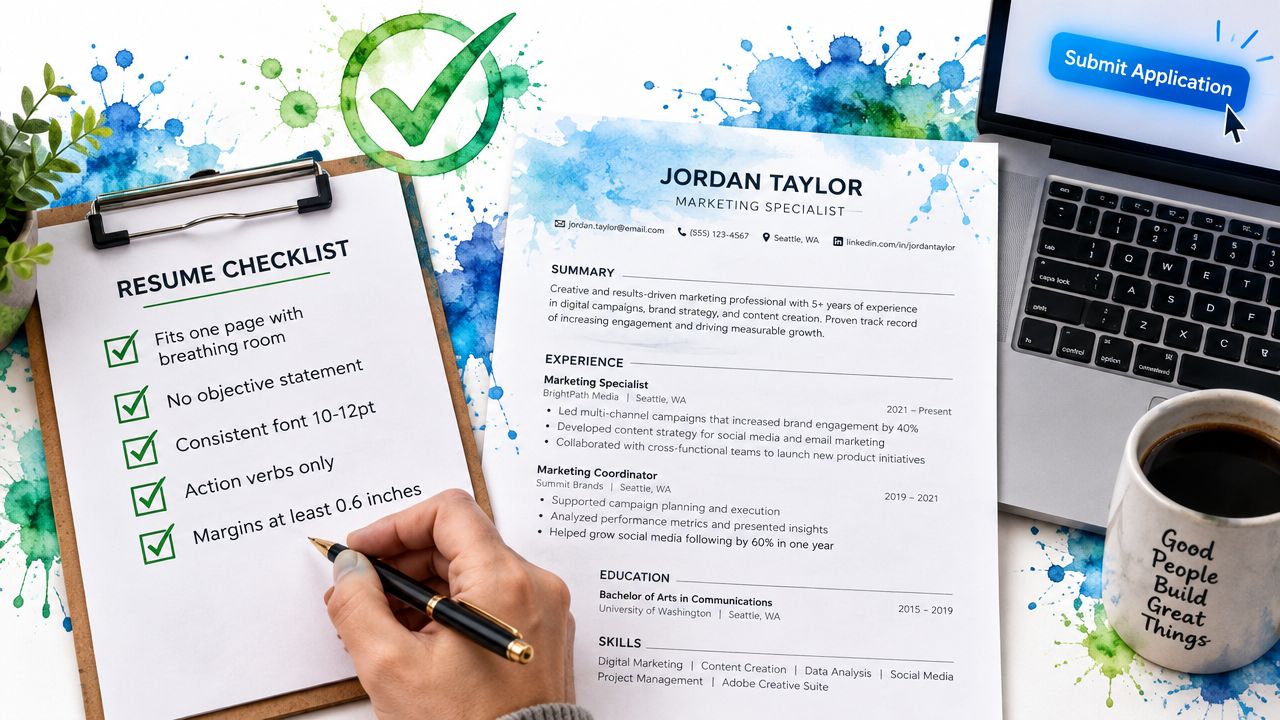
Confirm the page: Keep one page only if it fits with breathing room. If it needs tiny type or crowded margins, remove content before changing readability.
Test every bullet: Keep bullets that show a metric, outcome, deliverable, scope, or clear contribution. Cut duty-only statements.
Check the top roles: Put the two strongest and most relevant roles at the top of the experience block. Don't give equal space to weaker history.
Merge skills and tools: Use one tight block aligned with the vacancy. Remove tools that aren't relevant or current.
Remove paragraphs: Convert role descriptions into concise bullets. A paragraph signals that the candidate hasn't prioritised evidence.
Expose remote fit: Keep the contact line and relevant remote-work signal visible near the top. A distributed employer shouldn't have to hunt for location, time-zone availability, or remote collaboration context.
Use a readable file: Submit an ATS-readable format and follow the employer's instructions. Standard text, headings, and bullets are safer than visual elements.
Tailor one line: Add a role-specific summary or achievement line that reflects the actual remote vacancy. A generic resume wastes the most valuable space.
Run the seven-second test: Give the page to a reader for 7 seconds, then ask what role the candidate targets and what evidence supports the fit. The scan benchmark comes from recruiter eye-tracking research summarised by CNBC. (CNBC's coverage of resume length and recruiter scanning)
A resume isn't the only public signal in a remote search. Candidates should also check public profiles and learn how to remove red flags from social before applications reach a hiring manager.
For keeping applications, versions, and follow-ups organised, our Job Search Tracker can sit alongside the resume workflow.
A candidate should submit only when the document makes the role fit visible quickly, accurately, and without apology.
The next action is straightforward: open the resume, create a targeted copy for the next distributed role, and cut every line that doesn't prove relevance. If the evidence fits cleanly on one page, send it. If the second page adds necessary, role-specific proof, keep it and make every line earn its place.