

Skills based hiring judges candidates on demonstrated, job-relevant capability, and treats degrees as a supporting signal rather than an automatic gate.
The popular advice is thinner than that. Drop the bachelor line, post the advert, and call the process reformed. That shortcut still fails people. A hiring manager can delete a credential and then spend the interview asking where someone studied, which logo sat on their last contract, or how many years a title lasted.
A product designer in Lagos and a support engineer in Kraków can both look light on paper and still do the work. The model is real only when the same tasks are scored for everyone, including skills learned through freelance work, open source, or another country's workplace, and when a gap after the offer has a funded plan instead of a quiet return to old filters.
What skills based hiring means in practice
Say a team needs someone who can diagnose a failing integration, write a clear note for the customer, and decide when to escalate. A computer science degree suggests the person was taught. It does not show whether they can handle the live fault.
Think of a driving test. A school certificate shows they sat in a classroom. The test shows whether they can handle the road.
Skills based hiring evaluates people mainly on capabilities they can show, instead of using a bachelor degree or a past job title as an automatic screen. Employers name the technical, cognitive, behavioural and job-specific skills a role needs. They then check those skills with work samples, structured interviews, practical tests, portfolios, certifications or proof of earlier performance.

The World Economic Forum's 2025 Future of Jobs research, based on more than 1,000 companies, found that nearly 40% of the skills required on the job are expected to change by 2030. In that research, 63% of employers cited skills gaps as the biggest barrier to business transformation, 70% expect to hire people with new skills, and 85% plan to prioritise workforce upskilling.
Degrees are not banned. Education history becomes a supporting signal, not the gate.
Three questions for any advert
- Essential skills named: Does the advert list the skills the work needs, rather than only a degree or a title?
- Evidence requested: Does the interview ask for proof of those named skills?
- One written rubric: Is every candidate scored against the same criteria?
A process that fails any of the three is not yet skills based, even if the degree line has gone. For how employer language is moving ahead of practice, the HiredBySkill note on skills-based hiring trends for 2026 sits well beside that check.
If the degree line vanished but the interview is still a chat about where someone studied, the process is not skills based yet.
How skills replace credentials in the decision
Proxy screening asks whether someone has a degree or a similar title. Construct-based assessment asks whether they can perform the task to a stated standard. A realistic work sample takes a slice of the job. Education and titles only hint at it.
The OECD treats skills based hiring as matching a vacancy to the specific skills the role needs, rather than leaning on qualifications or previous job titles. Its model works in any country, because it changes the decision, not the local diploma name.
- Identify priority roles with the people who know the work, not only with a template from HR.
- Rewrite the job description around required skills, and mark each skill essential or preferred. A clear job description is the artefact the later score depends on.
- Change selection so structured assessments and competency interviews carry the decision, instead of an unstructured chat.
- Extend the same skill language into performance management, progression and personalised development, so the hire is not judged later on a different list.
Credential screening versus skills based hiring
| Decision point | Credential screening | Skills based hiring |
|---|---|---|
| First screen | Degree or similar job title | Evidence the person can do the core tasks |
| Job advert | Qualification and years of experience | Essential skills separated from preferred skills |
| Capability test | Unstructured conversation | Work sample, rubric or structured interview |
| Role of a degree | Automatic gate | Supplementary signal only |
| Sign of success | Faster filtering of CVs | Scores later linked to performance and retention |
| Global or remote roles | Local credential treated as universal | Standard instructions, accessible tools and jurisdiction-neutral evidence |
Read the rows as one hiring decision, not six slogans. The first screen stops being a credential filter and becomes proof of core tasks. The advert stops listing years and starts splitting essential skills from preferred ones. The capability test stops being a conversation and becomes a work sample, a rubric or a structured interview.
A degree then sits as a supplementary signal. Success is not a faster CV pile. It is scores you can later tie to performance and retention. For global or remote roles, local credentials stop acting as a universal standard. Instructions, tools and evidence stay usable across borders.
Candidates crossing fields can show that shift in the CV itself. A practical walk-through of translating past experience into resume impact helps when the proof sits in a different job title.
Run this table against one live role before you change tools or policy. The audit should use a real advert, not a theory deck.
How employers assess skills fairly
A test can be just as arbitrary as a degree requirement if nobody has thought through what it measures. A vague task, a sample rooted in one culture, or an exercise a disabled candidate cannot complete will swap one proxy for another and call it merit.
The operational gap is already measured. In the Hays skills research, 52% of Australian employers identify assessing candidate skills as a barrier, 49% cite redefining roles and processes, and 49% cite training hiring managers. That training gap bites hardest with informal evidence: many hiring managers have never been taught how to weigh a certification or an online degree against what a role requires.
Ways to assess job skills
| Method | Best for | Fairness watch-out | Evidence to accept |
|---|---|---|---|
| Work sample or simulation | Core tasks of the role | Time, tools, language and disability access; pay substantial work | Timed task scored on a published rubric |
| Structured interview | Judgement and collaboration | Identical questions and scores for every candidate | Behaviour examples tied to the named skill |
| Portfolio or project record | Creative and technical output | Do not favour one national presentation style | Annotated work that states the person's own role |
| Certification or online learning | Narrow technical knowledge | Many managers cannot interpret these alone | Certificate plus a short applied sample |
| Prior performance record | Proven delivery across employers | Job titles differ by country; ignore brand prestige | Outcomes, references and documented outputs |
Each method has one job. A work sample or simulation checks core tasks. Watch time limits, language, disability access and unpaid labour, and pay when the task is substantial. Publish the scoring rubric so candidates know what a good answer looks like. Teams that need to manage timing for pre-employment assessments should set the clock in the instructions, not in a surprise email.
A structured interview checks judgement and collaboration. Every candidate gets the same questions and the same score scale, so answers can be compared rather than guessed at. A portfolio checks creative or technical output, with the person's own role written on the work, not a house style imported from one country.
A certification or online course covers narrow technical knowledge. Pair it with a short applied task, because many managers cannot read the certificate alone. A prior performance record should be judged on outcomes, references and documented outputs. Ignore employer-brand prestige, and do not treat one country's job titles as the dictionary.
What fair means on a distributed team
Use the same instructions, a written rubric and reasonable adjustments for every candidate. Prefer documented project outputs and simulations that do not depend on a local campus or a live time zone. That is the practical test when you hire across borders.
Then check the instrument itself. Compare assessment scores with later performance, quality of work, retention and time to productivity. If scores predict nothing, the test is a new credential, and a missing degree line is not evidence that the process works.
Where the model helps and where it fails
A degree requirement removed from a job advert is a policy change, not a hiring change. The evidence for that gap comes from a joint study by Harvard Business School's Managing the Future of Work Project and the Burning Glass Institute, which examined 11,300 roles at large firms using career histories covering 65 million US workers. Where bachelor requirements were removed, the share of workers without a bachelor's degree hired rose by about 3.5 percentage points. Only 3.6% of the analysed roles dropped the requirement, so the overall effect was roughly 97,000 additional opportunities a year for candidates without degrees, out of about 77 million hires.
Read those results together. A 3.5 percentage point shift is a real change in who passes the gate, but it applied to a thin slice of roles. Some employers changed the advert and not the shortlist, and in a minority of firms the early gains faded. Removing the filter is the cheap part. Replacing it with a scored assessment is where the cost and the benefit sit.

Wider surveys measure intent rather than that hiring shift. TestGorilla's 2024 State of Skills-Based Hiring report found 81% of surveyed employers using skills based hiring in 2024, up from 73% in 2023. A 2025 SHRM report summarising a survey of 1,000 hiring managers found that 21% of companies had removed four-year degree requirements for at least some positions in 2024. Lightcast and Boston Consulting Group, looking at more than 20 million job postings, found skills based hires had 9% longer organisational tenure than traditional hires.
Skills-based hiring statistics: what each figure measures
| Measure | Result |
|---|---|
| Roles where a degree requirement was removed | Hiring of workers without a bachelor's degree rose about 3.5 percentage points |
| Share of analysed roles that dropped the degree requirement | 3.6% |
| Overall extra hiring of candidates without degrees | Roughly 97,000 opportunities a year out of about 77 million hires |
| Employers reporting skills based hiring (TestGorilla, 2024) | 81%, up from 73% in 2023 |
| Companies removing four-year degree requirements for some roles (SHRM, 2025) | 21% in 2024 |
| Tenure of skills based hires (Lightcast and Boston Consulting Group, 2023) | 9% longer than traditional hires |
Treat the adoption percentages as intent, and the 3.5 percentage point shift as the test of whether selection changed.
Where the assessment is genuine, the gains are concrete: a wider pool, a stronger performance signal and slightly longer stays. The failure modes are just as concrete. A policy that rewrites the advert but not the scoring leaves the shortlist looking like the old one. So does a process that cannot read informal evidence: a self-taught portfolio, a freelance track record or a qualification from another country only counts if someone has agreed how to score it. Grouping work into clear job families makes that harder to dodge, because the same skills then have to be scored the same way across related roles.
What to do when a new hire still has a gap
Hiring on demonstrated skill means buying the core tasks and owning the rest together. Every hire arrives with a gap; a skills based process just writes it down, because the rubric already recorded what was scored and what was waived. A degree hides the same gap until it hurts.
In the World Economic Forum's 2025 employer survey, organisational resistance to change was a barrier for 46% of respondents, inadequate data and technical infrastructure for 32%, while 84% of surveyed employers said they had the resources to close skills gaps. Money for closing gaps is easier to find than agreement on what the gap is.
The post-hire system
- Written expectations at day 30, 60 and 90: Define what good looks like in outputs a reviewer can check, dated before the person starts.
- Structured onboarding: Access, context and a first real task inside week one.
- A named manager: One person owns the feedback. A committee owns nothing.
- Learning budget and mentoring: Fund the gap already named at offer, and pair the hire with someone who does that work daily.
- A path to move: Internal roles written in the same skill language as the rubric, so moving up is scored the same way as coming in.
Who pays, and how long ramp-up lasts
Budget for the gap you knew about at offer, and for gaps created when tools change after the person starts. If any training cost is meant to sit with the employee, check the rules where they work first: repayment and clawback terms differ by country, so confirm them under local employment law before they reach a contract. Optional development beyond what the role requires can sit with the employee.
Judge ramp-up by time to a defined output. A support engineer's first solo ticket or an analyst's first accepted model is a measurable milestone; there is no universal number of weeks. Review ramp-up inside the probation window already used in that country.
A hiring error is when the person cannot do a skill the rubric marked as required. An under-supported employee never received the training, access or manager time that was promised. The first is a selection miss; fix the rubric. The second is a management miss; fix the plan.
Teams that restore degree screens after one difficult nontraditional hire should name which miss they had.
Agree the gap, the budget and the review date in the offer conversation. If those three are missing, the hire is still being treated as fully formed.
How to present your skills as a candidate
Finish this routine for one application. Do not build a generic profile and hope a recruiter translates it.
- Copy the essential skills from the advert and ignore preferred fluff. This stops you answering a job they did not post.
- Choose two proof types that match those skills. A work sample, a portfolio piece, a certification plus a small task, or a measured outcome from freelance, open-source or employed work is enough. More certificates do not help.
- Annotate each piece with your role, the constraint, the result and the tool. A reviewer in another country should not have to guess what you did.
- Mirror the skill words the employer used. Do not pad the CV with unrelated courses. Our Resume Builder is built to shape a CV around the posting rather than a generic profile, and our resume examples show how that reads in practice.
- Keep a running record so the next application does not start from a blank page. Our Job Tracker Chrome Extension saves roles and lets you compare them with what similar applicants showed.
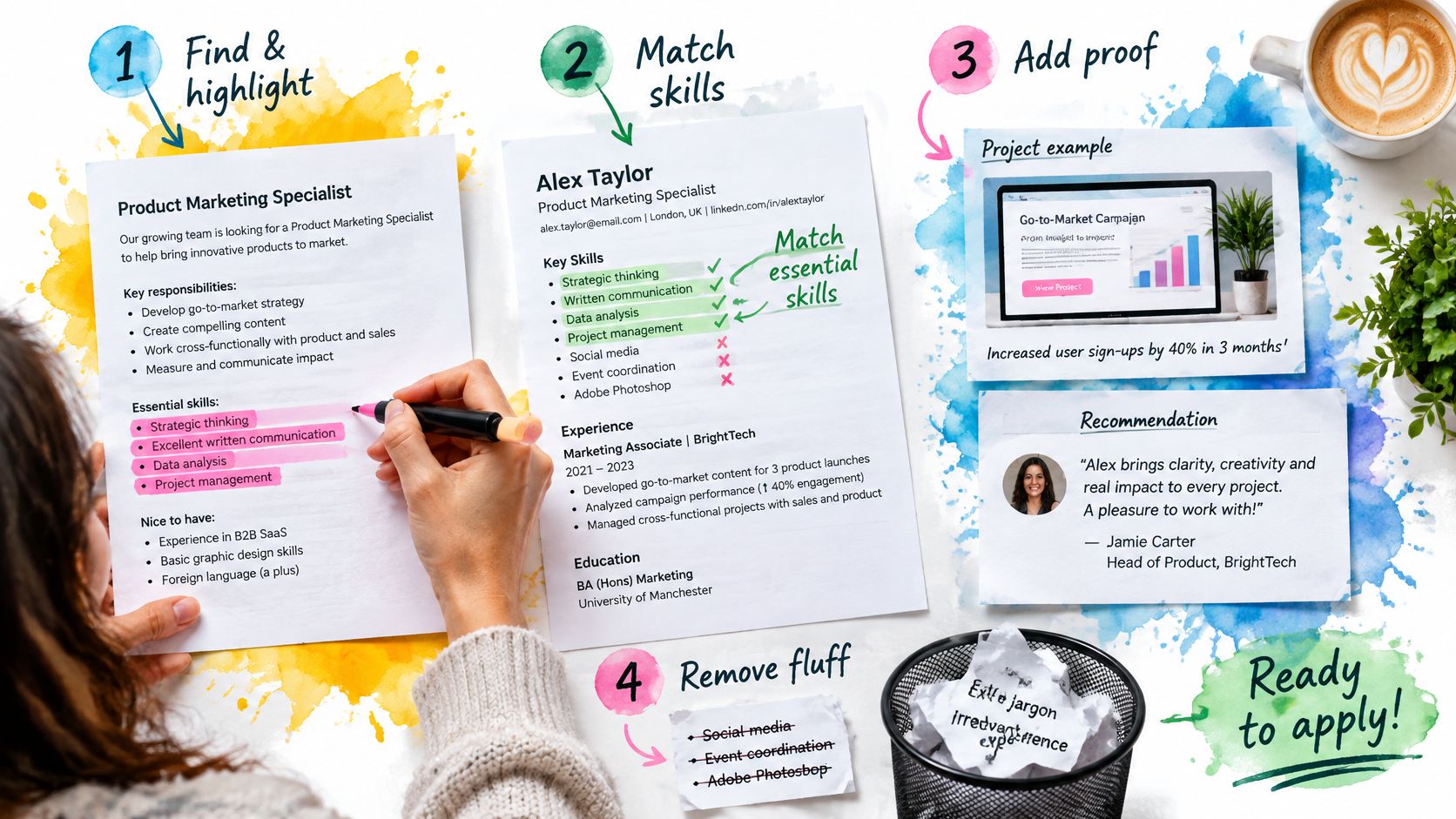
Two proofs, not a university name
A designer in Lagos links a client prototype to an interaction-design skill. The note says they owned the flows, worked inside a two-week constraint, and shipped a clickable prototype in Figma. The university line can stay off the first screen.
A support engineer in Poland attaches a troubleshooting write-up. It names the failing integration, the checks they ran, the customer impact, and the fix. The reader sees the skill. They do not need the campus.
Skip three habits that waste the application. Do not dump every course you have finished. Do not hide your part on a team project. Do not send an unpaid multi-day build.
Publishing a short career update can surface recent work to employers who screen on skills. Attach one annotated proof to the next application this week.
Choose your next move on skills based hiring
The right move depends on the seat you sit in this week. Adoption slogans do not tell you which one.
Candidates should apply through skills based hiring when the advert names essential skills and you can show them, even without the usual degree or a matching title. Skip employers whose process is still an unstructured chat. Ask which assessment will be used before you invest time in a test. Your action is to confirm that format before you apply.
Hiring managers should adopt skills based hiring for roles where core tasks can be sampled fairly. Do not announce it for regulated jobs where a licence or a degree is a legal requirement. Your action is to rewrite one job around essential skills and score the next shortlist with one rubric.
People teams on distributed work should adopt it only when rubrics, reasonable adjustments, paid tests and a 90-day support plan are ready. Your action is to check that the assessment does not depend on a single campus or a live time zone. Roles listed as remote jobs still fail that test if the exercise assumes one office and one clock.
Readers who want market context can use our research on skills and pay before they freeze a range or a rubric. Pick the action that matches your seat, and do it before the next requisition or the next application goes out.
Open one live role this week and run the three-question check. If you are hiring, rewrite that advert around essential skills and book the assessment before you open the shortlist. If you are applying, attach one annotated proof and ask what the score will measure. That is how skills based hiring stops being a line in a policy and starts being a decision you can defend.