

Skills-based hiring judges candidates on job-relevant skills they can demonstrate, and treats a degree as a supporting signal rather than an automatic gate. Deleting the degree line from your advert is not enough: the same scored tasks have to decide who gets through. If the interview still asks where someone studied, which logo sat on their last contract or how long a title lasted, nothing has changed.
A product designer in Lagos and a support engineer in Kraków can both look light on paper and still do the work. Your process is skills-based only when the same tasks are scored for everyone, including skills learned through freelance work, open source or another country's workplace. It also needs a funded plan for any gap after the offer, not a quiet return to old filters.
What skills-based hiring means
You name the technical, cognitive, behavioural and job-specific skills a role needs. Then you check them with work samples, structured interviews, practical tests, portfolios, certifications or proof of earlier performance. A bachelor degree or past job title stops being an automatic screen.
For example, a computer science degree suggests someone was taught to diagnose a failing integration. It does not show whether they can handle the live fault.

Skills needs are shifting fast. The World Economic Forum's 2025 Future of Jobs research draws on more than 1,000 companies. It found that nearly 40% of the skills needed on the job are expected to change by 2030.
In the same research, 63% of employers cited skills gaps as the biggest barrier to business transformation. Employers also said they expect to hire people with new skills (70%) and plan to prioritise workforce upskilling (85%).
Three questions for any advert
- Essential skills named: Does the advert list the skills the work needs, rather than only a degree or a title?
- Evidence requested: Does the interview ask for proof of those named skills?
- One written rubric: Is every candidate scored against the same criteria?
If your process fails any of the three, it is not yet skills-based, even if the degree line has gone. Employer language is moving faster than practice, as HiredBySkill's note on skills-based hiring trends for 2026 shows.
How skills replace credentials in your process
Credential screening asks whether someone has a degree or a similar title. Skills-based assessment asks whether they can do the task to a stated standard. A realistic work sample takes a slice of the job; education and titles only hint at it.
The OECD treats skills-based hiring as matching a vacancy to the specific skills the role needs, not to qualifications or previous job titles. That works in any country, because it changes the decision, not the name of the local diploma. Four steps put it into your process:
- Pick priority roles with the people who know the work, not only with an HR template.
- Rewrite the job description around required skills, and mark each one essential or preferred. A clear job description is what the later score depends on.
- Change selection so structured assessments and competency interviews decide, not an unstructured chat.
- Use the same skill language in performance reviews, progression and development, so the hire is not judged later on a different list.
Credential screening versus skills-based hiring
Here is how the two approaches differ at each decision point.
| Decision point | Credential screening | Skills-based hiring |
|---|---|---|
| First screen | Degree or similar job title | Evidence the person can do the core tasks |
| Job advert | Qualification and years of experience | Essential skills separated from preferred skills |
| Capability test | Unstructured conversation | Work sample, rubric or structured interview |
| Role of a degree | Automatic gate | Supplementary signal only |
| Sign of success | Faster filtering of CVs | Scores later linked to performance and retention |
| Global or remote roles | Local credential treated as universal | Standard instructions, accessible tools and jurisdiction-neutral evidence |
Career changers often hold the proof under a different job title. This walk-through on translating past experience into resume impact shows how they can bring it to the surface of a CV.
How to assess skills fairly
A test can be as arbitrary as a degree requirement. A vague task, a culture-bound sample or an exercise a disabled candidate cannot complete swaps one proxy for another and calls it merit.
Employers already struggle here. In the Hays skills research, 52% of Australian employers named assessing candidate skills as a barrier. Redefining roles and processes and training hiring managers were each cited by 49%.
Training matters most with informal evidence. Many hiring managers have never learned to weigh a certification or an online degree against what a role needs.
Ways to assess job skills
Each method suits different skills and carries its own fairness risk.
| Method | Best for | Fairness watch-out | Evidence to accept |
|---|---|---|---|
| Work sample or simulation | Core tasks of the role | Time, tools, language and disability access; pay substantial work | Timed task scored on a published rubric |
| Structured interview | Judgement and collaboration | Identical questions and scores for every candidate | Behaviour examples tied to the named skill |
| Portfolio or project record | Creative and technical output | Do not favour one national presentation style | Annotated work that states the person's own role |
| Certification or online learning | Narrow technical knowledge | Many managers cannot interpret these alone | Certificate plus a short applied sample |
| Prior performance record | Proven delivery across employers | Job titles differ by country; ignore brand prestige | Outcomes, references and documented outputs |
Publish the scoring rubric and put any time limit in the instructions, so every candidate knows what good looks like before they start. Tools that manage timing for pre-employment assessments can then enforce the clock you set. Pay for any task that takes more than a couple of hours.
What fair means on a distributed team
Give every candidate the same instructions, a written rubric and reasonable adjustments. Prefer documented project outputs and simulations that don't depend on a local campus or a live time zone. That's why the We Are Distributed hiring network is organised by craft, 189 of them, so you can search by the work a person does.
Then test the test. Compare assessment scores with later performance, quality of work, retention and time to productivity. If scores predict nothing, you have built a new credential.
What changes when you drop degree requirements
Removing a degree requirement from an advert changes policy, not hiring. A joint study by Harvard Business School's Managing the Future of Work Project and the Burning Glass Institute shows why. It examined 11,300 roles at large firms, using career histories covering 65 million US workers.
Where bachelor requirements were removed, the share of workers hired without a bachelor's degree rose by about 3.5 percentage points. But only 3.6% of the roles dropped the requirement. The overall effect was roughly 97,000 extra opportunities a year for candidates without degrees, out of about 77 million hires.
So the shift was real but thin. Some employers changed the advert and not the shortlist, and in a minority of firms the early gains faded. Removing the filter is the cheap part; replacing it with a scored assessment is where the cost and the benefit sit.

Skills-based hiring statistics: what each figure measures
Wider surveys track adoption and tenure rather than hiring outcomes. They include TestGorilla's 2024 State of Skills-Based Hiring report and a 2025 SHRM report on a survey of 1,000 hiring managers. A 2023 analysis by Lightcast and Boston Consulting Group looked at more than 20 million job postings.
| Measure | Result |
|---|---|
| Roles where a degree requirement was removed | Hiring of workers without a bachelor's degree rose about 3.5 percentage points |
| Share of analysed roles that dropped the degree requirement | 3.6% |
| Overall extra hiring of candidates without degrees | Roughly 97,000 opportunities a year out of about 77 million hires |
| Employers reporting skills-based hiring (TestGorilla, 2024) | 81%, up from 73% in 2023 |
| Companies removing four-year degree requirements for some roles (SHRM, 2025) | 21% in 2024 |
| Tenure of skills-based hires (Lightcast and Boston Consulting Group, 2023) | 9% longer than traditional hires |
Treat the adoption percentages as intent, and the 3.5 percentage point shift as the test of whether selection changed.
When the assessment is genuine, you get a wider pool, a stronger performance signal and slightly longer stays. When it isn't, the shortlist looks like the old one.
That happens if you rewrite the advert but not the scoring. It also happens if nobody has agreed how to score a self-taught portfolio, a freelance track record or a qualification from another country. Clear job families make that harder to dodge, because related roles then score the same skills the same way (see how we map product marketing).
What evidence to ask candidates for
Ask for proof tied to your advert, not a generic profile.
- Essential skills only: Ask candidates to prove the essential skills, not the preferred ones.
- Two proof types: Any two of a work sample, a portfolio piece, a certification plus a small task, or a measured outcome from freelance, open-source or employed work. More certificates do not help.
- Annotated work: Each piece should state the person's role, the constraint, the result and the tool. A reviewer in another country should not have to guess what they did.
- Your skill words: A strong CV mirrors the language of your advert instead of listing unrelated courses. Our resume examples show how that reads.
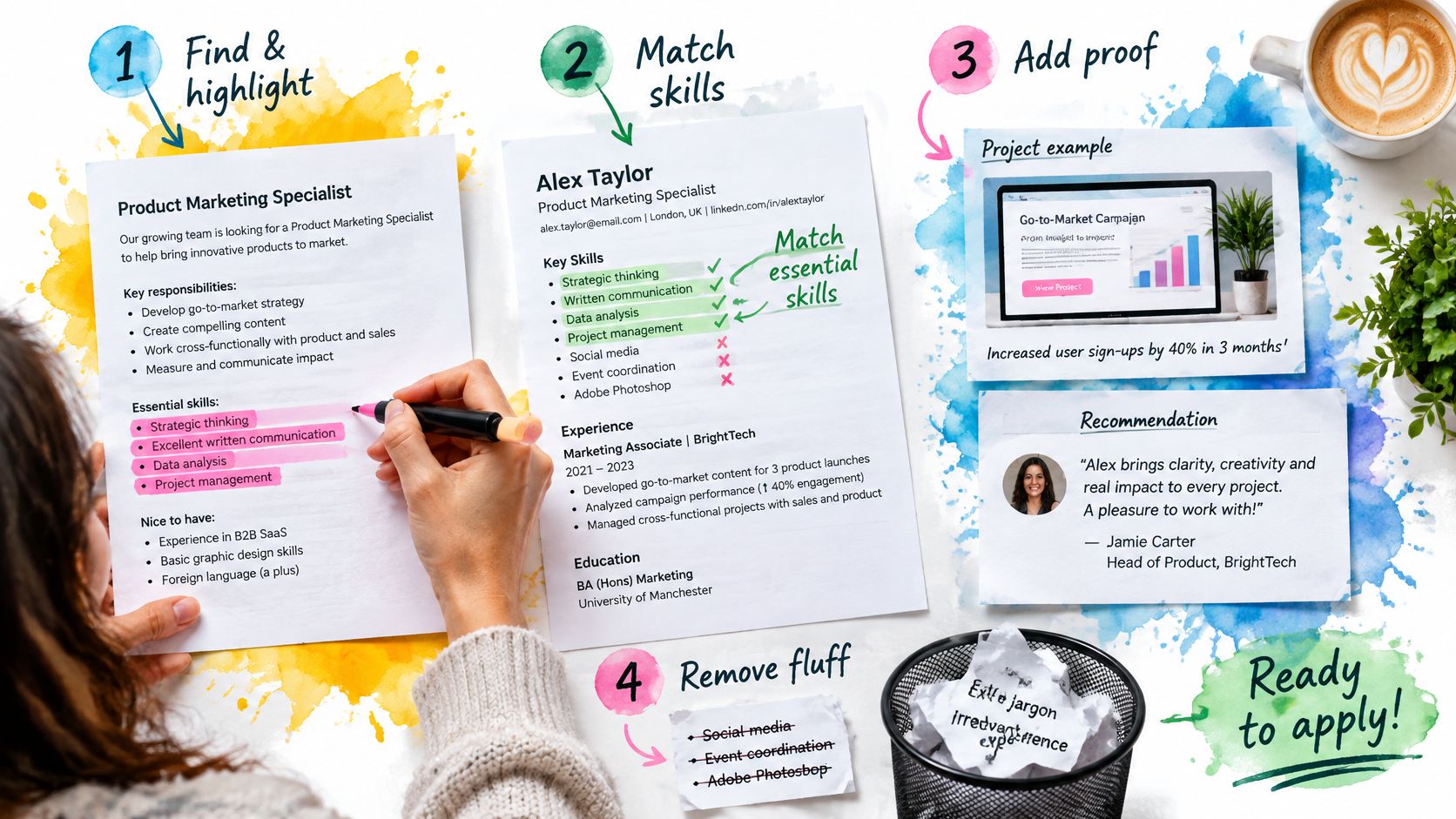
Hypothetical example: two proofs, not a university name
A designer in Lagos links a client prototype to an interaction-design skill. The note says they owned the flows, worked to a two-week constraint and shipped a clickable prototype in Figma.
A support engineer in Poland attaches a troubleshooting write-up. It names the failing integration, the checks they ran, the customer impact and the fix. You see the skill without needing the campus.
How to close a new hire's skill gap
Every hire arrives with a gap. A skills-based process writes it down, because the rubric recorded what was scored and what was waived. A degree hides the same gap until it hurts.
In the World Economic Forum's 2025 employer survey, 84% of employers said they had the resources to close skills gaps. The barriers lay elsewhere: organisational resistance to change for 46%, and inadequate data and technical infrastructure for 32%. Money is easier to find than agreement on what the gap is.
The post-hire system
- Written expectations at day 30, 60 and 90: Outputs a reviewer can check, dated before the person starts.
- Structured onboarding: Access, context and a first real task in week one.
- A named manager: One person owns the feedback. A committee owns nothing.
- Learning budget and mentoring: Fund the gap named at offer, and pair the hire with someone who does that work daily.
- A path to move: Internal roles written in the rubric's skill language, so moving up is scored the same way as coming in.
Who pays, and how long ramp-up lasts
Budget for the gap you knew about at offer, and for gaps created when tools change after the person starts. Optional development beyond the role can sit with the employee. If you want any training cost to sit with them, confirm repayment and clawback terms under local employment law first, because they differ by country.
Judge ramp-up by time to a defined output, such as a support engineer's first solo ticket or an analyst's first accepted model. There is no universal number of weeks. Review ramp-up within the probation window already used in that country.
A hiring error means the person cannot do a skill the rubric marked as required: fix the rubric. An under-supported employee never got the training, access or manager time you promised: fix the plan. Before you restore degree screens after one difficult nontraditional hire, name which miss you had.
Agree the gap, the budget and the review date in the offer conversation. If any of the three is missing, you are still treating the hire as fully formed.
When to adopt skills-based hiring
Use it for roles where you can sample the core tasks fairly. Don't announce it for regulated jobs where a licence or a degree is a legal requirement.
On distributed teams, wait until rubrics, reasonable adjustments, paid tests and a 90-day support plan are ready. Check that the assessment doesn't depend on a single campus or a live time zone. Remote roles on our job board still fail that test if the exercise assumes one office and one clock.
Start with one role: rewrite it around essential skills and score the next shortlist against one rubric. The policy becomes real when the same scored task decides who gets the job, in every country you hire from.